Book Review: ANGUS, THONGS, AND FULL-FRONTAL SNOGGING
*Note: this blog was created for a class at TWU

1. BIBLIOGRAPHY:
Rennison, Louise. 1999. ANGUS, THONGS, AND FULL-FRONTAL SNOGGING. New York, NY: HarperCollins Publishing.

2. PLOT SUMMARY:
Georgia Nicholson just wants three simple things: to be left alone by her parents, Uncle Eddie, and three-year-old sister, to hang out with her friends, and to have a boyfriend. In ANGUS, THONGS, AND FULL-FRONTAL SNOGGING, Georgia's diary entries reveal that she gets at least two of her wishes, along with always funny, sometimes sad ups and downs of being a teenager.

3. CRITICAL ANALYSIS:
As a self-proclaimed non-chicklit reader, I was ready to hate this book, but the funny title, and the Britishness of it drew me in since I spent three of my own early teen years living "on the economy" in the small British town of Bury. And I wasn't disappointed. ANGUS, THONGS, AND FULL-FRONTAL SNOGGING is laugh-out-loud, tears streaming from your eyes funny.

Written in diary form, Georgia's voice immediately shines through. She laments that her Uncle Eddie ("bald as a coot") treats her like a child and wishes she could scream at him, "I am bursting with womanhood, I wear a bra! OK, it's a bit on the loose side and does ride up round my neck if I run for the bus..." And that's just the first entry. Alternating between scathingly funny observations about the world, "Someone farted in assembly this morning...Whoever it was, it was really loud and during the silence we were having to think about all the poor people. And it wasn't just a quick one, it was a knee-trembler," and self-deprecating commentary on herself, "In my room in front of the mirror. Practicing smiling without making my nose spread. It's impossible. I must never smile again."

Yet sprinkled among the silly, funny, episodes of home, school, friends, and growing up, are some honest lessons about self-acceptance and not trying to grow up too fast. Georgia is the friend we all had who could make us laugh when things got tough, who always had the fun, crazy ideas, and didn't let what others thought stop her from being herself. I'd recommend ANGUS, THONGS, AND FULL-FRONTAL SNOGGING to any teen girl, although the author's constant use of slang and dry wit might cause some reluctant readers to struggle (although there is a "dictionary" in the back). And if the books aren't enough, her website has "fabbity-fab" extras such as the snogging scale and dance moves! http://www.georgianicolson.com/index.html

Louise Rennison captures voice of a teen much like Meg Cabot does, but with even more wicked humor, and less fantasy elements (princesses, saving The President, mediating with the dead), so I would definitely put it in the read-alike list with THE PRINCESS DIARIES, a cute little series by Nancy Krulik called HOW I SURVIVED MIDDLE SCHOOL, and SISTERHOOD OF THE TRAVELING PANTS by Ann Brashares.

4. REVIEW EXCERPT(S):
School Library Journal: "It will take a sophisticated reader to enjoy the wit and wisdom of this charming British import, but those who relish humor will be satisfied. Fresh, lively, and engaging."

The Guardian: "You know when you really should stop laughing and everyone is looking at you? This was me reading the manuscript on the train. This is a brilliant book! ... I can't recommend it highly enough."

5. CONNECTIONS
* I don't know if there are any curricular connections with this book, since it's just plain fun, but I did think it might be neat to do a display of books that include lists as a story element. ANGUS, THONGS has "Six Things That Are Very Wrong With My Life," ALL-AMERICAN GIRL has "Top Ten Reasons I Wish I Were Gwen Stefani" among others, K.L. Going's book THE LIBERATION OF GABRIEL KING has his list of greatest fears (with humor), and HOW I SURVIVED MIDDLE SCHOOL has multiple lists such as "How I Know My Best Friend Is Really My BFF." I could then have a competition where students could submit their own funny lists. It could be done at the end of the school year, and the lists could be "Top Ten Ways to Survive Middle School/Seventh Grade/Algebra." Or maybe the ELA teachers could use that as a journal entry and springboard into listing as a drafting technique or story element. Lists are fun!

Book Review: A WREATH FOR EMMETT TILL
*Note: this blog was created for a class at TWU

1. BIBLIOGRAPHY:
Nelson, Marilyn. 2005. A WREATH FOR EMMETT TILL. Boston, MA: Houghton Mifflin Company.

2. PLOT SUMMARY:

Marilyn Nelson's book tells the story of Emmett Till, a fourteen-year-old boy who was murdered in 1955 because of his race, in the form of a heroic crown of fifteen interlinked sonnets, with each sonnet beginning with the last line of the preceding sonnet.

3. CRITICAL ANALYSIS:

Many Americans know the story of Emmett Till's brutal murder and the subsequent trial in which the white men accused of the murder were found not guilty through documentaries and history books on the civil rights movement, but Emmett's story has never been told in such a unique, personal, and moving way as in A WREATH FOR EMMETT TILL.

Beautifully illustrated by Philippe Lardy in a symbolic, collage-like style, A WREATH FOR EMMETT TILL begins with a note from the author explaining how she came to write a book about this horrific incident that she remembered happening when she was nine. The complex poetic form was, for her, a protection "from the intense pain of the subject matter, and a way to allow the Muse to determine what the poem would say."

Nelson's first sonnet considers what flowers would be chosen for Emmett's wreath, drawing from the language of flowers, a theme she twines, like a wreath, throughout the poems. The flowers are accompanied by the underlying structural theme of the tree, at times rotten to the core, at times the keeper of history (through its rings), and at times the bearer of death in lynching. Echoing these central themes, the illustrations incorporate elliptic shapes to recall the wreath and, as the artist explains in the note at the end of the book, "the 'cosmic egg,' the mythological origin of the universe."
There are a lot of layers here for the reader. For more advanced readers, vocabulary such as "dendrochronology," "populace," and "consciencelessness" would be an enticing challenge. In addition, each of the fifteen sonnets is full of allusions, which the author explains in a commentary at the back. Yet even without fully understanding the allusions, the poems' emotionally charged words and imagery combine with the content to create a powerful whole that would capture the interest of even reluctant readers. In the sonnet describing Emmett's mother's preparations for his train trip, the language is simple and heart wrenching:

and comic books. She'd given him a note
for the conductor, waved to his chubby face,
wondered if he'd remember to brush his hair.
Her only child. A body left to bloat.

The picture accompanying it on the next page is equally haunting, showing Emmett, peering through an oval, as if through the train window, surrounded by thorns, chains, and the five crows, waiting to lynch him. The boy's expression is one of curiosity and anticipation for the adventures he hopes to have on this trip to visit his aunt and uncle. He cannot see and could not imagine the horrors awaiting him outside the train.

Because of the multiple layers, A WREATH FOR EMMETT TILL has something for everyone: the poetry lover, the voracious reader, the reluctant reader, the visual learner, the child, and the adult. It is a beautiful and respectful homage the boy whose death has become a symbol of the ignorance and hatred the world needs to eradicate from our hearts.


4. REVIEW EXCERPT(S)
Booklist (starred review): "When matched with Lardy's gripping, spare, symbolic paintings of tree trunks, blood-red roots, and wreaths of thorns, these poems are a powerful achievement that teens and adults will want to discuss together."

School Library Journal: "This memorial to the lynched teen is in the Homeric tradition of poet-as-historian. . . . This chosen formality brings distance and reflection to readers, but also calls attention to the horrifically ugly events."

5. CONNECTIONS
* Using an Elmo or other document camera, this book would be a powerful read-aloud in the social studies or language arts classroom. The teacher could show the illustrations while reading the text. A WREATH FOR EMMETT TILL would be an excellent mentor text for a poetry unit that went beyond the usual haikus, acrostic poems, biopoems, and diamantes we see in many middle and high school classrooms. I think in our district, students write some form of biopoem every year between 7th and 10th grade. Enough! It might help students not only write poetry which is deeper and more symbolic, but also technically more complex. While it would be difficult to write a heroic crown of sonnets, students could choose an element to explore such as iambic pentameter, the sonnet rhyme scheme, or the idea of writing a cycle of poems in which the last line of the preceding poem became the first line of the next poem. For the visual learners, the collage-like illustration techniques would also be an element to explore in illustrating poems.

Book Review: Fallen Angels
*NOTE: This book review was created for a class at TWU.


1. BIBLIOGRAPHY: Myers, Walter Dean. FALLEN ANGELS. 1988. New York, NY: Scholastic, Inc.

2. PLOT SUMMARY: Inner-city teen Richie Perry enlists in the Army after high school graduation to help earn money for his mother and little brother, but gets sent into combat in Vietnam where he makes friends for life, witnesses man's inhumanity to man, and searches for the role he will play in his own future.

3. CRITICAL ANALYSIS:

Walter Dean Myers, one of America's preeminent African-American authors for young adults, is noted not only for his ability to accurately describe the lives of young urban African-American teens, in novels such as MONSTER and SHOOTER but also for the variety of his work in both genre and content. From the diverse poetry of HERE IN HARLEM to the historical details of Victorian England in AT HER MAJESTY'S REQUEST, Myers takes any topic he chooses and makes it accessible, personal, and deeply reflective.

In FALLEN ANGELS, Myers draws from his own life and experiences to weave a story of growing up, finding friendship, and discovering one's role in the world through the horrific combat of the Vietnam War. He says, "My ideas come largely from my own background. I write a lot about basketball, and I've played basketball for years and years. I was in the army and I wrote FALLEN ANGELS. I lived in Harlem, and I write about Harlem... Ultimately, what I want to do with my writing is to make connections--to touch the lives of my characters and, through them, those of my readers." (www.teenreads.com) Myers' dedication to the novel reveals an even stronger connection to the war, as he honors his brother "whose dream of adding beauty to this world through his humanity and his art," ended when he died in combat in Vietnam.

Like Myers, the novel's main character, Richie Perry, joins the Army right after graduating from high school in Harlem, hoping to send money home to help his mother and younger brother, but also hoping never to see real combat. After a basketball injury, he is supposed to have a medical "profile" preventing combat duty, but as a result of the military's slow and arbitrary system of red tape, Perry finds himself in the "boonies" of Vietnam, witnessing horrors no one should ever face. Between intense scenes of battle, Perry and the friends he makes in his company try to make sense of the meaning of life and their roles in the world.

The beauty of FALLEN ANGELS lies in its complexity and clarity. Surrounding the story of Perry are important questions of race, sexuality, class, power, and ambition. The racial tensions go both ways, from the soldier who wants all the African-Americans to swear allegiance to each other, to the commander who seems to give the worst jobs to them. One soldier is gay, another Jewish, while others are fighting to rise in rank, or to fulfill the dreams of their parents. Yet all these differences melt away when the men fight with and for each other to survive. In the end, that seems to be the message Myers wants us to hear most clearly in FALLEN ANGELS. On the novel's last page, Perry, wounded but returning home, prays for the "fallen angels," the wounded, and those still fighting, "I knew I was mixing my prayers, but it didn't matter. I just wanted God to care for them, to keep them whole."

In 1989, a year after the novel was first published, it received the Coretta Scott King Award, and was named an ALA Best Book for Young Adults. Since then, FALLEN ANGELS has been challenged at many high schools and middles schools for its language, graphic violence, and sexual content, but without these elements, the story wouldn't ring true, and to focus on them is to dwell on the details and miss the heart of the novel. I would recommend this novel to many young adults, and to all teachers of US History, especially 11th Grade Social Studies teachers in Texas.

4. REVIEW EXCERPT(S):
Kirkus (pointed review): "War-story fans will find enough action here, though it isn't glorified...thoughtful readers will be haunted by this tribute to a ravaged generation."

Booklist (starred review): "...this gut-twisting Vietnam novel...breaks uncharted ground."

5. CONNECTIONS:
* 11th Grade Social Studies: this novel would be a great class novel to read or literature circle read during units on the Vietnam War. An excellent photoessay lesson plan using the novel can be found at: http://www.galileo.org/schools/strathmore/english/english_33/index.html, along with a Thinkquest multimedia introduction.

Book Review: AMONG THE HIDDEN
*NOTE: This blog was created for a class at TWU.


1. BIBLIOGRAPHY:
Haddix, Margaret Peterson. 1998. AMONG THE HIDDEN. New York, NY: Aladdin Fiction.

2. PLOT SUMMARY:
Luke Garner is the "hidden" third child in a totalitarian society where families are limited to two children, and people live within a strict class system. Because a new housing development is encroaching on the family farm, Luke must never go outside or even look out the window for fear that the "Population Police" will discover his existence. But when Luke makes a discovery of his own, that another "hidden" has moved in next door, he learns the truth about himself and the world in which he lives.

3. CRITICAL ANALYSIS:

During adolescence, young adults often question authority and their right to freedom as they explore their own identities and assert their independence. In doing so, they also engage in "social perspective taking," or seeing an issue from another person's point of view. Dystopian titles such as Margaret Peterson Haddix's AMONG THE HIDDEN tap into this developmental stage of exploration by allowing young adults to experience a world in which people are much less free than they are in our society today, seeing it, in this case, from the point of view of a boy their own age, who, due to government restrictions, should never have been born.

Reminiscent of Lois Lowry's THE GIVER, Haddix's series, of which AMONG THE HIDDEN is the first installment, paints a picture of a society, not too different from our own, where the people in power have taken away the freedom of the population in order to "protect" them. In THE GIVER, society was protected from memories and emotions that were strong enough to result in conflict, anger, and sorrow, but paid the price by losing the other end of the spectrum: joy, diversity, and triumph. Haddix's society is "protected" from food and energy shortages through population control and a strict class system. Although their lives are happy, they've lost the freedom to have more than two children, buy what they want, and live as they want. Luke comes to the realization that if he remains hidden, he will never be free, but that he may pay for his freedom with his life. The action is fast-paced and the vocabulary is accessible, making it a quick read for even reluctant readers.

As a teacher, one of the most valuable parts of the novel is the way in which Luke Garner learns why he must stay "hidden." Jen, the "hidden" child who lives next door gives Luke stacks of books and articles discussing the issue of population control from both the point of view of the government and those who oppose the two children per family policy. He discovers the concept of bias and also the ways in which groups of people can attempt to change government policy by writing to media, staging rallies, and infiltrating the government itself. At the same time, his eyes are opened to the hypocrisy of the ruling class "barons" who break and flaunt the rules almost as a status symbol.

Bias and hypocrisy are difficult concepts to teach, and with students getting much of their information from the internet and media, it is vital that they look at information with a critical eye. AMONG THE HIDDEN provides a concrete and thought-provoking example by which to discuss bias, hypocrisy, and the role of the government in our lives.

At the end of the novel, Jen attempts to confront the government with the existence of the "hidden" and pays for her act of defiance with her life. She had argued that hope wouldn't change the world, only action would, but in reflecting on her death, Luke has a revelation that there are different kinds of actions, just as there are different perspectives. "Maybe he could succeed where Jen failed," he thinks, "precisely because he wasn't a Baron - because he didn't have her sense that the world owed him everything. He could be more patient, more cautious, more practical." Haddix then leaves the reader to pick up the next volume and cheer Luke on in his quest to free the "hidden" shadow children.

AMONG THE HIDDEN has won numerous awards and was both a Top 10 ALA Best Book for Young Adults and an ALA Quick Pick for Reluctant Young Adult Readers.

4. REVIEW EXCERPT(S):
Publisher's Weekly: "the unsettling, thought-provoking premise should suffice to keep readers hooked."

School Library Journal (gr. 5-8): "As in Haddix's Running Out of Time (S & S, 1995), the loss of free will is the fundamental theme of an exciting and compelling story of one young person defying authority and the odds to make a difference. Readers will be captivated by Luke's predicament and his reactions to it."

5. CONNECTIONS
* Middle School English Language Arts classrooms could use this novel as part of lessons on point of view and persuasive writing. The class could read it together, analyzing the arguments for and against population control and control of food/energy resources. Then, as a group project, students could choose a book out of the "What's That Got to Do With Me?" series of titles from Smart Apple Media. Topics include racism, elections, war and conflict, drugs, etc., and each title shows different points of view through personal stories, articles, and interviews. Students could then choose to create a PPT presentation aimed at persuading the audience to agree with their stand on the issue, write a letter to a government official persuading him/her to take a stand on the issue, perform a debate giving pros and cons, or write a fictional story like "Among the Hidden" using information on their issue.

Book Review: A STEP FROM HEAVEN
*NOTE: This review was created for a class at TWU.

1. BIBLIOGRAPHY:
Na, An. 2001. A STEP FROM HEAVEN. Asheville, NC: Front Street. ISBN 1886910588

2. PLOT SUMMARY: In An Na's bittersweet realistic novel, A STEP FROM HEAVEN, Young Ju, a Korean girl, grows up, learns to make her way in America, and struggles to deal with her father's alcoholism and abuse.

3. CRITICAL ANALYSIS:
Often, a writer's first novel contains a very strong voice, but lacks craft, or vice versa. The 2002 ALA Printz Award-winning novel A STEP FROM HEAVEN is an exception, combining a clear voice with a well-crafted plot and structure. An Na's novel spans a girl's life from toddler to university student, and while the novel incorporates themes prevalent in realistic young adult fiction such as independence, generational conflict, powerlessness and dominance, rebellion and self-awareness, it also reflects the protagonist's journey into adulthood with a unique structure.

First, A STEP FROM HEAVEN addresses Young Ju's forays into independence, from the first resistance as a five year old to being pretty because it means "you cannot play in your nice clothes," to the young woman who is able to make straight A's in school, clean house, buy groceries, and cook while her mother works 3 jobs to keep the family together. Young Ju keeps the meaningful ways of her Korean past, but also forges her own path in America, becoming her mother's "strong girl."

The ways of the past, including traditional values such as being an obedient daughter and being subservient to the males in the family, creates a generational conflict between Young Ju and her parents, in particular, her father. As Young Ju matriculates through the American school system, she assimilates in to American culture, and cannot help but compare her family dynamics with those of her friend Amanda. In the chapter entitled "Daughter," Young Ju gets a ride home from an award ceremony at school where she was named 1st in her class. In the car, she smiles as Amanda's father begins to sing along to the radio, and winks at the girls in the rear view mirror. It is a stark contrast to what Young Ju finds at home. While her mother is very pleased with the girl's award, her father makes no mention of it and appears not to even have looked at it until Young Ju notices it has a smudge on it and smells like him, indicating he did see it. Her inability to have a close and loving relationship with her father tears at her, and she thinks, "An ache deep and wide as the sea threatens to drown my heart."

Yet, the conflict in Young Ju's family stems from more than the strictness of a tradition Korean family hierarchy. Young Ju's father, or Apa, is both alcoholic and abusive. Her mother, or Uhmma, is powerless to leave him, and any of her own small acts of rebellion such as demanding to know where he's been are rewarded with slaps and punches. Once Young Ju and her brother Joon are older, they both become victims of abuse, learning to "look blank as if you are listening when really you are trying to fly away from your body" in the face of the verbal abuse that always precedes the beatings. When Uhmma is nearly killed trying to protect Young Ju, the girl finally tips the scales on her father's dominance by calling 911. Although Uhmma refuses to press charges, this act ends the family's powerlessness, and eventually Apa returns to Korea without them.

In addition, A STEP FROM HEAVEN is a deeply personal account of a girl's developing self-awareness. And it is this theme which is most reflected in the novel's structure. Without being contrived, An Na succeeds in creating a narrative voice which ages as Young Ju ages. The first chapters are very short, with simple thoughts and sentences. "Cold. Cold water. Oh. My Toes are fish. Come here. Fast. Look." thinks the toddler Young Ju. Later, on her first day of school in America, five-year-old, Young Ju muses, "I think future must mean a long time away. Except school is not in the future. It is now. I do not understand how school is my future when it is not a long time away." Compare this to the self-assured narration of Young Ju as a high school senior, "The patch of grass is so small you can walk across in four long strides. But I don't care. It is ours. I walk barefoot back and forth across the vibrant green lawn, take in deep breaths of air. My toes clutch the tiny blades, revel in the softness and the damp earth beneath my feet. All ours."

Interwoven within the change in narrative style is not only Young Ju's growth as a young woman, but also her acclimation to America and the English language. Whereas the early chapters are filled with words and phrases she doesn't know yet such as when the teacher says "All right, class, come over here," and Young Ju hears "Ah ri cas, ca mo ve he," the quote above shows a woman whose vocabulary includes words such as "strides," "vibrant," and "clutch." The vivid words of a college bound graduate.

Finally, A STEP FROM HEAVEN, which deals with such difficult issues as abuse and acoholism, is an honest look at the complexity of family dynamics and life. A close look at the structure of the novel reveals that the chapters loosely alternate between good and bad memories, beginning and ending with a good memory. In the beginning, we have the happy memory of a toddler getting her first feeling of being in the ocean, under the safe and comforting watch of a loving relative, whom I assumed to be her grandmother. In the end, sifting through photographs, Young Ju sees one of her with her father, and that memory resurfaces, revealing that her father wasn't always an abusive, distant alcoholic. After living through Young Ju's terrible suffering, the reader glimpses Apa as a dreamer, with a "broad grin" and eyes which crinkle "like the eyes of sleepy cats in the sun," reminding us that people change, and perhaps forgiveness can heal.

An Na's bittersweet optimism, honesty, and shunning of didacticism, along with her evolving narrative style, bring A STEP FROM HEAVEN to a level above many young adult accounts of growing up. Readers will be able to connect with the struggles of Young Ju, and will rejoice in her independence, while gaining an understanding of the immigrant experience.

4. REVIEW EXCERPT(S)
BOOKLIST: (Starred Review) "This isn't a quick read, especially at the beginning when the child is trying to decipher American words and customs, but the coming-of-age drama will grab teens and make them think of their own conflicts between home and outside. As in the best writing, the particulars make the story universal."

PUBLISHERS WEEKLY: "In fluid, lyrical language, Na convincingly conveys the growing maturity of her perceptive narrator who initially (and seamlessly) laces her tale with Korean words, their meaning evident from the context. And by its conclusion, readers can see a strong, admirable young woman with a future full of hope. Equally bright are the prospects of this author; readers will eagerly await her next step."

5. CONNECTIONS & STRATEGIES

* At the high school level, this book would be a good choice for a thematic unit on the immigrant experience in America. Pair A STEP FROM HEAVEN with other titles such as Sandra Cisneros's A HOUSE ON MANGO STREET (ISBN 0679734775) and REMIX: CONVERSATIONS WITH IMMIGRANT TEENAGERS (ISBN 0805051139) by Maria Tamar Budhos,to help students identify issues immigrant teens have at home, in school, and with the older generation. The teacher may want to find people in the community who would be willing to talk about their own immigrant experience and allow the students to conduct their own interviews in person or via email. For an insightful interview with An Na in which she discusses the influence of Sandra Cisneros's novel on her work, go to : http://www.cynthialeitichsmith.com/lit_resources/authors/interviews/AnNa.html

* Since A STEP FROM HEAVEN ends with a new beginning and revelations about Young Ju’s father, it would a good candidate for an activity called “The Rest of the Story.” Students create a summary of the story and then tell “the rest of the story” a la Paul Harvey using the subtext or a follow-up that wasn’t explicitly told. They might explore what happens later, whose story wasn’t told and now will be told, or what new twist or information might be added. For this lesson and other ideas on how to deepen students’ comprehension of texts, see Jeffrey Wilhelm’s ACTION STRATEGIES FOR DEEPENING COMPREHENSION (ISBN 0439218578)

Book Review: THE GIVER
*NOTE: This review was created for a class at TWU.

1. BIBLIOGRAPHY:
Lowry, Lois. 1993. THE GIVER. New York, NY: Dell Laurel Leaf. ISBN 0440237688

2. PLOT SUMMARY:
In THE GIVER, Lois Lowry's 1993 Newbery Medal-winning novel, Jonas lives in a world without fear or pain. All aspects of life in the community are stable, polite, and completely under the control of the Committee of Elders, from birth to death. This state of existence is fine with Jonas until, at the age of twelve, he is unexpectedly named Receiver of the community's collective memories. These memories are transmitted to him by the Giver, and as Jonas learns what has been sacrificed for the sake of stability, he realizes that he must risk everything and escape.

3. CRITICAL ANALYSIS:

"But at the same time, he was filled with fear. He did not know what his selection meant. He did not know what he was to become.
Or what would become of him." (The Giver, Ch. 8)

In four short sentences, Jonah, the main character of THE GIVER, conceptualizes the fear and uncertainty felt by all young adults when confronted with what they will become in the future and what society expects them to become. The simplicity of the world Lois Lowry creates in this novel, coupled with the spare and direct style of narration, allows the author to bring many of the major themes in young adult literature to the forefront of THE GIVER, resulting in a story which is both thought-provoking and unique in its clarity.

Because the prevailing themes in young adult literature include self-awareness and rebellion against the established order, the genre of dystopia is particularly suited this type of literature. As young adults become more aware of themselves in a quest to discern what their individual identity is, they in turn become more aware of the world around them and begin question the status quo. Dystopias add an element of fantasy, such as magic and other worlds, to this journey of self-discovery, often pitting the protagonist against newly discovered evil, transforming self-discovery into heroism. THE GIVER is a dystopia which succeeds in doing all this in a style that is engaging and touching without flowery prose that would distract from the important questions raised by Jonas's plight.

In the beginning, Lowry paints a picture of life which, while not perfect, is safe and comforting in its sameness. Everyone knows the rules and the status quo prevails. Students begin each day with "chanting" and a "morning anthem," performing polite public apologies when rules are broken, and being reminded over loudspeakers of the consequences of infractions. Each day ends with a ritual too, "the evening telling of feelings." While this stable life seems gentle and protective, Jonas's increasing sense of self-awareness causes him to be uncomfortable with the constraints of his community. He is reluctant to engage in the telling of feelings, finding them to be too complex, thinking that, "He wanted to share them, but he wasn't eager to begin the process of sifting through his own complicated emotions, even with the help that he knew his parents could give."

By the time Jonas is singled out from the rest of his age group to be appointed the special job of Receiver, his journey of self-discovery has also become a journey toward independence. This journey is facilitated by his growing curiosity about the world around him. Jonas questions everything, and is encouraged by his mentor, the Giver of memories. When he begins to see colors, he questions why no one else can see them. "Why can't everyone see them?" Jonas asks, "Why did colors disappear." At this point, Jonas learns that colors were "relinquished" when the community did away with differences, gaining control of one thing, but having to give up others.

From here, THE GIVER becomes dystopic, and Jonas's realization that the loss of freedom, beauty, and passion are too great a price to pay for sameness and safety, turns his journey of self-discovery into a quest for survival. When he decides to flee the community, which would release the memories he has received back to everyone, he takes with him Gabriel, a baby who going to be killed because he didn't fit in to the community's norms. At this moment, he heroically risks his own life, and transforms himself from Receiver of memories to Giver of life and the future. Almost dead with exhaustion, hunger, and cold, Jonas protects the baby and becomes "aware with certainty and joy that below, ahead, they were waiting for him; and that they were waiting, too, for the baby."

Lowry offers an optimistic ending echoing with allusions to the nativity, but one which is open-ended enough for the reader to form his or her own interpretation. THE GIVER is not didactic. In fact, this very open-endedness has caused the book to be controversial to some, who see in some of the Biblical allusions such as Jonas's and Gabriel's name, and the Christmas-time setting, a condemnation of religion. Yet it is that very freedom of interpretation for which the novel stands. THE GIVER poses serious questions about society's constraints in the interest of the "common good" without giving answers so that, like Jonas, the reader can "sift through" his or her own complicated thoughts independently.

4. REVIEW EXCERPT(S)
School Library Journal: (Starred Review) "The final flight for survival is as riveting as it is inevitable. This tightly plotted story and its believable characters will stay with its readers for a long time."

Booklist: (Starred Review) "The simplicity and directness of Lowry's writing force readers to grapple with their own thoughts."

5. CONNECTIONS & STRATEGIES
* Use color and music to springboard a discussion about the things the community gives up in order to be more "secure" and "safe." Put large sheets of butcher paper in different colors around the room. Students stand at each sheet for five minutes, writing down the things and feelings that come to mind when they think about that color. Then do a gallery walk, discussing each color and reflecting on feelings and connotations that shared by our society and why a society might want to avoid those feelings and connotations. A similar exercise would be to play clips of various songs and have students journal about the emotions those songs evoke. Why would a community want to ban music? Finally, students could journal on what things (if any) they would be willing to give up to make their community safer. For a lesson plan along these lines, go to http://www.teachers.net/lessons/posts/664.html

* At the high school level, this book would be an excellent choice in a genre study of dystopias in a book study or reader's circle format. The teacher could do brief book-talks about 5-6 dystopias such as Aldous Huxley's BRAVE NEW WORLD (ISBN 0060929871), Ray Bradbury's FARENHEIT 451 (ISBN 8445074873), George Orwell's 1984 (ISBN 0451524934), and Margaret Atwood's A HANDMAID'S TALE (ISBN 038549081X). Along with these classics, some contemporary dystopias include M.T. Anderson's FEED (ISBN 0763622591), Scott Westerfield's UGLIES (ISBN 0689865384) and PRETTIES (ISBN 0689865392), Susan Beth Pfeffer's LIFE AS WE KNEW IT (ISBN 0152058265), and Nancy Farmer's HOUSE OF THE SCORPION (ISBN 0689852231). After the book talks, student self-select which book they'd like to read and create groups of students who are reading the same book. Through journals, textual analysis, and discussion, students will identify the elements of a dystopia found in the book and report out to the rest of the class. Students may be assigned roles such as Connection Maker, Illustrator, Vocabulary Sleuth, etc., so that each will have an important part to play in the work and presentations. Harvey Daniels has some great ideas for book clubs in Ch. 9 of his book, SUBJECTS MATTER (ISBN 0325005958)

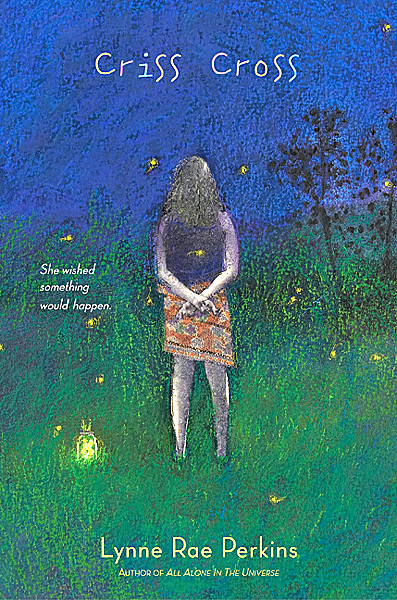
Book Review: CRISS CROSS
*NOTE: This review was created for a class at TWU.

1. BIBLIOGRAPHY:
Perkins, Lynne Rae. 2005. CRISS CROSS. New York, NY: Greenwillow Books. ISBN 0060092726

2. PLOT SUMMARY:
The Newbery Award-winning novel CRISS CROSS weaves a story of interconnected lives and moments of missed meaning. The main character, Debbie, and her group of friends all sense that they are on the verge of something, yet feel that nothing ever happens in their small world, centered around the town of Seldem. Each of them is constantly changing and growing, taking in new experiences like a sponge, especially Debbie. She learns to fix a sink, drive a stick shift, pop the clutch to start a dead battery, and stave off an elderly neighbor's diabetic episode with orange juice and sugar, and in one synchronicitous morning, she must do all of these things, leading her to also find, for three brief days, what might be love with Peter. But life goes on, her love returns to California, and Debbie and her friends connect and miss connections all over again.

3. CRITICAL ANALYSIS:
The Russian writer Marina Tsvetaeva once said that poets don't compose poetry, they just tune their inner antennae to the cosmos and let it fill them up. But the question arises, while you're tuned into the cosmos, what are you missing on earth? In much the same way, the characters in Lynn Rae Perkins' realistic young adult novel, CRISS CROSS, are, at various times, tuned into new experiences that shape their developing identities, while missing other connections that might have profoundly impacted them. The author's language, illustrations, and multi-genre format reinforce both the coming-of-age story and pondering of concepts such as fate, destiny, and man's own inability to be "tuned in" to life.

While on one level CRISS CROSS meditates upon philosophical questions of existence and the meaning of life, it is ultimately a realistic novel of growing up that bears the hallmarks of the best of today's young adult literature. First, the novel is written from the viewpoint of young people and details their struggles to become independent. Debbie, Hector and all their friends could live right down the street from any of us, and their struggles to begin to define themselves, such as changing clothes on the way to school, learning to play guitar, ditching their glasses, and letting their hair grow out, can be seen on any high school campus today. This urgent need to be different from the children their parents still saw them as is described as "cultural evolution," away from "mothers who were stranded in the backwaters of a bygone era" and who weren't "going to get it" no matter how much you argued. In her gently humorous way, Debbie resolves the problem by stating, "At some point you just had to go change your clothes in a bush."

The gentle and humorous narrative style points to another characteristic of quality young adult literature; CRISS CROSS is not didactic. The adolescents in the novel do have moments of insight and grapple with important emotions, but they stay in character, not dwelling or lecturing, but moving on to the next event in their lives. When Hector is chastised by Patty for not recognizing that girls like boys for their looks, just as boys like girls for their looks, he reflects that he "saw what she was getting at, but he didn't think it applied. He liked Meadow for her inner beauty. Which happened, in her case, to be accompanied by outer beauty. He thought her outer beauty might even be a result of her inner beauty. A time honored line of reasoning that encompasses both truth and quicksand." Hector goes on to hope his own inner beauty was visible from the outside, commenting, "I'm a hunk in my soul." The prose balances insight and humor to both address and assuage the fears and concerns that can sometimes overwhelm adolescents.

Finally, the real genius in Perkins' book lies in the way the multi-genre structure supports the story. This structural support is particularly evident in two themes: the idea that we are more or less "tuned in" to life at certain times, and the idea that although we sometimes miss connections, if those connections are meant to be made, they will be made at another time. The first concept is embodied by the term "satori," which comes from Zen Buddhism and is loosely defined as a moment of individual enlightenment. Though this concept may seem esoteric, it is made approachable in the second chapter when Hector is taken out of his usual surroundings and joins his sister in a coffeehouse to listen to music. Perkins writes, "He didn't realize he was in a sponge state but, having been separated from his moorings - couch, TV, pizza - and led into unfamiliar territory, there was a spongy piece of him left open and receptive to the universe in whatever form it might take, and the form it took was a guitar." Later, this state is described as satori, "a mystical, wordless moment of understanding about Music and Life..." and illustrated with photographs of the Civic Arena's roof opening when the weather clears, beautifully representing the abstract concept in concrete detail. Visual representation of an emotional state is exemplified in Chapter 22, "Wuthering Heights/Popular Mechanics" where the entire chapter is placed on the page in the form of two columns, the left hand column bearing Debbie's experience, and the right-hand column simultaneously describing Lenny's experience, which is frustratingly parallel, but off by moments, resulting in the two characters missing a chance to connect with one another by a paragraph.

Other states and emotions are explored through haiku, fable, script, and cartoon, creating a layered effect which belies the surface simplicity of the spare prose and, with the exception of the day Debbie saved Mrs. Bruning from a diabetic seizure, mundane events. And, ultimately, that may be the lesson to be learned from CRISS CROSS. Things are not as they appear on the surface, and missed opportunities may come again, because, although we fail to connect all the time, if we keep "tuning in" to the universe, we will connect and achieve moments of satori. Achieving individual enlightenment, however fleeting, brings us to a final characteristic of outstanding young adult literature - optimism. CRISS CROSS is optimistic. The novel ends with lightning bugs blinking their "Here I am," ready to make the next connection, achieve satori, and maybe even true love, encouraging the reader to follow nature's lead and continue to let her light shine. Taken together, the realism, depth of thought, optimism, and structural complexity of CRISS CROSS combine to create a Newbery-worthy novel.

4. REVIEW EXCERPT(S)
School Library Journal: (Starred Review) "There is a great deal of humor in this gentle story about a group of childhood friends facing the crossroads of life and how they wish to live it. Young teens will certainly relate to the self-consciousnesses and uncertainty of all of the characters, each of whom is straining toward clarity and awareness."

Booklist: (Starred Review) "...most readers will find their contemporaries in these characters. Best of all are the understated moments, often private and piercing in their authenticity, that capture intelligent, likable teens searching for signs of who they are, and who they'll become."

5. CONNECTIONS & STRATEGIES
*At the high school level, this novel could be studied in conjunction with other books or stories that call into question whether there is such a thing as "destiny" or are we simply buffeted by series of coincidental events? Is there a greater plan? In groups, students could list the "near misses" and "coincidences" in the novel, and develop an argument as to whether they think the author, Lynne Rae Perkins, is arguing that there is true love out there, and, in spite of many near misses, it will find you, or that we're all just victims of happenstance. Then, looking at it from a philosophical point-of-view, students could read some of the stories in COINCIDENCE OR DESTINY? STORIES OF SYNCHRONICITY THAT ILLUMINATE OUR LIVES (ISBN 157324824X) and take their own stand on the issue, using the stories as evidence. Or, looking at it from a "scientific" standpoint, they could read A LITTLE BOOK OF COINCIDENCE (ISBN 0802713882), which guides the reader through the solar system, pointing out beautiful patterns in nature, and leading to the question, could something so beautiful and perfect, just be chance?

* CRISS CROSS would be an excellent selection when looking at multi-genre writing. Avi's book, NOTHING BUT THE TRUTH (ISBN 038071907X) would be another good novel to use as a mentor text for multi-genre writing. Students could then try their own hand at writing about the same subject through different genres. It's an excellent way to discuss purposes for writing and point-of-view. A teacher's resource book for approaching multi-genre writing in the classroom is Tom Romano's BLENDING GENRE, ALTERING STYLE: WRITING MULTI-GENRE PAPERS (ISBN 0867094788).


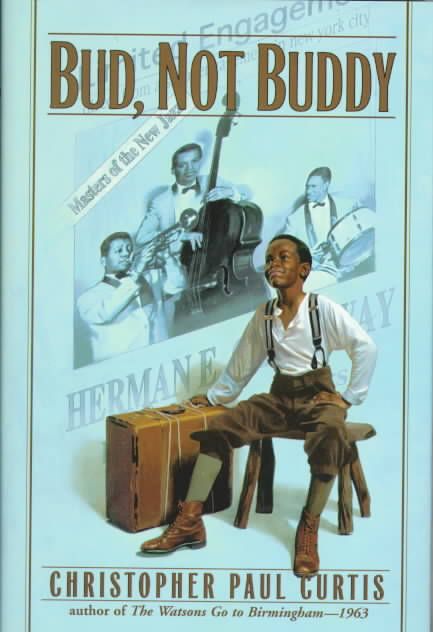
Book Review: BUD, NOT BUDDY
*NOTE: This review was created for a class at TWU.

1. BIBLIOGRAPHY:
Curtis, Christopher Paul. 1999. BUD, NOT BUDDY. New York, NY: Delacorte Press. ISBN 0385323069

2. PLOT SUMMARY:
In BUD, NOT BUDDY, Newbery Award-winning author Christopher Paul Curtis tells the Depression-era story of a young orphaned boy named Bud, who runs away from an abusive foster home and goes in search of his long lost father. Along the way, he draws upon the wisdom of his mother and his own wry sense of humor to survive, befriending a ragtag bunch of musicians and finally finding a home where he belongs.

3. CRITICAL ANALYSIS:
Christopher Paul Curtis's Depression era novel, BUD, NOT BUDDY, set a high standard for young adult historical fiction by seamlessly integrating the setting with characters who are real, believable, and relevant today. The themes of dignity under desperate circumstances, courage, and hope all accurately describe the spirit of those who survived the trials and tribulations of the Great Depression in America.

First, the setting is integrated in things Bud sees, places he goes, and the conversations he has with other characters. In chapter six, when Bud waits in line for food at the "mission," he sees a sign that aptly depicts the irony of the average American's situation in "the land of milk and honey." The sign portrays a rich family of four, with "big shiny eyes and big shiny teeth and big shiny cheeks and big shiny smiles," wearing "movie star clothes," and riding in a car that "looked like it had room for eight or nine more people in it." The top of the sign reads, "There's no place like America today," to which a character jokes, "Well, you got to give them credit, you wouldn't expect that they'd have the nerve to come down here and tell the truth." Later, Bud and a friend arrive in one of the "Hooverville" tent cities, bleakly described as "a bunch of huts and shacks throwed together out of pieces of boxes and wood and cloth." Yet, once again, Curtis relieves the dark situation with humor as a woman hands the boys "plates" for their meal. Bud narrates, "a woman handed me and Bugs each a flat, square, empty tin can. 'That, m'lords, is your china. Please be careful not to chip it.' My china had the words JUMBO A&P SARDINES stamped into the bottom of it."

Second, the characters in the story are real, believable, and relevant today, especially the protagonist BUD. Just as in the thirties, 21st century children are growing up with single parents, and most people can relate to Bud's stash of sentimental objects that serve as memories of a distant relative or loved one. Anyone who has searched for someone or longed to know someone better can relate to Bud's quest to find his father. If Bud's desires and motivations are relevant, his thoughts and speech make him real and believable. Phrases such as "get holt," "kiss my wrist," and "woop, zoop, sloop," bring Bud's voice to life, and once he meets up with H.E. Calloway and the Dusky Devastators of the Depression, the boys in the band breath life into the lingo of the times with words like "chops," "scoop," "cop a squat."

While historically accurate, BUD, NOT BUDDY is most memorable for the truly charming and witty voice of its eponymous main character. Through Bud's eyes, Christopher Paul Curtis reveals the gritty realities of the Depression era, and compassionate characters whose strong doses of humor help everyone to keep hope alive and survive one of the worst periods in our country's history. This was my second reading of this outstanding novel, and even though I knew how it ended, I still found myself crying right along with Bud when I got to Chapter 14.

4. REVIEW EXCERPT(S)
Children's Literature: "Curtis' book follows a young African-American boy as he struggles to find a home during the Depression. The author takes on a difficult time and seemingly sad plot, but Bud, the hero, has humor and originality that will open new doors and understanding about this era."

Publisher's Weekly: "As in his Newbery Honor-winning debut, The Watsons Go to Birmingham--1963, Curtis draws on a remarkable and disarming mix of comedy and pathos, this time to describe the travails and adventures of a 10-year-old African-American orphan in Depression-era Michigan."

5. CONNECTIONS & STRATEGIES
*Create a "Frozen Tableau" to help students better understand what it was like to live during the Depression. Give students copies of Depression Era photographs (perhaps the work of Dorothea Lange) and have students journal to react to them. In a discussion forum, clear up any misconceptions or confusion the pictures may have engendered. Then in groups, students pose as people in one of the pictures, creating a "frozen tableau." While in their frozen poses, the students answer questions from the teacher who acts as a "reporter," wanting to know the more about the people, the times, and the emotions in the picture. Use the instructions for creating a "Frozen Tableau" for THE WATSONS GO TO BIRMINGHAM as a guide. They can be accessed at: http://www.learner.org/channel/workshops/tml/workshop5/authors1b.html

* Compare and contrast the protagonists in A SINGLE SHARD (ISBN 044041581) and BUD, NOT BUDDY. Both novels tell the story of young orphaned boys trying to find their home in the world. I was struck by the similarities in the "wisdom" imparted to them by loved ones which each carried within them as a source of strength. Students could reflect on words of wisdom their own family and mentors may have imparted and write a short autobiographical narrative interweaving those words into the story.

Book Review: THE MIDWIFE'S APPRENTICE
*NOTE: This review was created for a class at TWU.
*Illustration by young artist from: www.dbrl.org/outreach/book-cover/03/

1. BIBLIOGRAPHY:
Cushman, Karen. 1995. THE MIDWIFE'S APPRENTICE. New York, NY: Clarion Books. ISBN 0395692296.

2. PLOT SUMMARY:
The Newbery Award-winning novel A MIDWIFE'S APPRENTICE weaves the coming-of-age tale of a young orphan girl, cruelly nicknamed "Dung Beetle" and "Brat," who, through hard work and perseverance, becomes a capable young woman, Alyce. Wanting only "a full belly, a contented heart, and a place in this world," Alyce suffers ostracism, disappointments, and crisis of faith in herself before coming to realize that her place in the world is as a midwife's apprentice, and her family is what she makes it: a bitter midwife, a stray cat, and a village full of characters.

3. CRITICAL ANALYSIS:
The hallmarks of good historical fiction include that the history is accurate, it isn't sugar-coated, it is seen through the eyes of a young protagonist, it comes to life through the patterns of daily life, and it isn't revealed through too much historical detail. Karen Cushman's novel A MIDWIFE'S APPRENTICE contains all these hallmarks along with a wonderful girl's coming-of-age story.

There can be no doubt that history isn't sugar-coated when a novel starts with the line, "When animal droppings and garbage and spoiled straw are piled up in a great heap, the rotting and moiling give forth heat. Usually no one gets close enough to notice because of the stench." In fact, most of the settings in THE MIDWIFE'S APPRENTICE reveal that medieval life didn't really resemble the Hollywood "knight saves princess" tales we've all come to love. No, in this story, boys torment cats, husbands cheat on wives, making soap stinks up the whole yard, and our young protagonist, Alyce, doesn't take a bath until 3/4 of the way through the plot!

If life is less than rosy, it is even more so through the eyes of the orphan girl known as Brat, Dung Beetle, and finally Alyce. While she begins the story with only an empty belly and hard experiences, her keen curiosity and perseverance leads her to a happy existence as the midwife's apprentice and allows the reader to soak in all the details of village life. Through her eyes, we learn that "columbine seeds speed birth" and cobwebs are used for "stanching blood," we see "pennants flying...copper kettles, rubies and pearls, ivory tusks from mysterious animals," and "pies stuffed with pork and raisins," at the market in Gobnet-Under-Green, and we feel the "stiff vellum" used by Master Reese to write his great encyclopedia. Because Alyce is so inquisitive by nature, these historically correct descriptions never feel unnatural, but rather is a natural extension of the daily patterns she experiences.

Only one section of the novel seemed less than realistic to me, and that was the chapter entitled "The Devil." While I enjoyed the descriptions of medieval superstitions, I had difficulty believing that Alyce, working most of the day as the midwife's apprentice, and having no real skills as a woodworker (even though it does mention she likes to watch the woodworker at work), would be able to carve two blocks to look like animal prints. Even if she could do that, how would she be able to use them to create a trail that led to someone committing an evil deed without also leaving footprints and/or being detected. And what are the chances that the townspeople would catch the culprits in the act every time? It just seemed far-fetched to me.

Yet the rest of the novel is delightfully fast-paced, and keeps a nice balance of historical detail and action. Karen Cushman works wonders with characterization, describing Jane the midwife as "a woman neither old nor young but in between. Neither fat nor thin but in between. An important-looking woman, with a sharp nose and a sharp glance and a whimple starched into sharp pleats." Other, more minor characters are characterized with similar care. Joan, the bailiff's wife, "washed her linen each week and never let herself be seen even in summer," and Master Reese was "long and skinny as a heron, with black eyes in a face that looked sad, hungry, and cold."

Like many young adult novels, THE MIDWIFE'S APPRENTICE is a bildungsroman of self-discovery, but Cushman avoids a Disney-like ending by foregoing hugs and happy reunions which would ring false in the difficult times of fourteenth-century England, and opting for a simpler closure. When Alyce finally regains the courage to return to the midwife after disgrace and ask to be an apprentice again, she is initially rejected, but perseveres, refusing to leave the midwife's front step, setting up the final scene: "The door opened. Alyce went in. And the cat went with her." We are left to speculate whether Alyce would grow up, become an even better midwife due to her caring heart, and fall in love with the local red-haired boy.

Delightful characterization, fascinating details, and a charming protagonist, make THE MIDWIFE'S APPRENTICE an enjoyable story for those who love medieval times, Chaucerian foibles, and spunky protagonists.

4. REVIEW EXCERPTS:

From School Library Journal: "Characters are sketched briefly but with telling, witty detail, and the very scents and sounds of the land and people's occupations fill each page as Alyce comes of age and heart. Earthy humor, the foibles of humans both high and low, and a fascinating mix of superstition and genuinely helpful herbal remedies attached to childbirth make this a truly delightful introduction to a world seldom seen in children's literature."

From Booklist: "The characters are drawn with zest and affection but no false reverence... Kids will like this short, fast-paced narrative about a hero who discovers that she's not ugly or stupid or alone."

5. CONNECTIONS
* Students could use THE MIDWIFE'S APPRENTICE as an introduction to a medieval unit in 6th grade social studies. After reading the novel, the class could split into groups, each taking a different village building (midwife's cottage, farm, woodworking shop, mill, tavern, manor) and research what it would look like an what it would contain. Then each group could create a three-dimensional model of the building, labeling important areas/items. After presentations, the buildings could be arranged to create an entire medieval village.
* Use in a girls' book club and compare to A DAUGHTER OF VENICE by Donna Jo Napoli (ISBN 0440229286) and TRUE CONFESSIONS OF CHARLOTTE DOYLE (ISBN 0380782550) by AVI. All three novels are historical, deal with a girl's coming of age, and the stereotypes and constraints put upon women during the time in which they lived. Discussions could center around the treatment of girls and women throughout cultures and history.

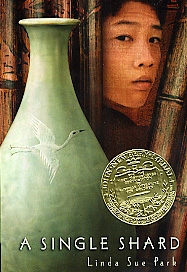
Book Review: A SINGLE SHARD
*NOTE: This blog was created as part of a class at TWU.

1. BIBLIOGRAPHY:
Park, Linda Sue. 2001. A SINGLE SHARD. New York, NY: Dell Yearling. ISBN 0440418518

2. PLOT SUMMARY: Set in 12th century Korea, the Newbery Award winning novel A SINGLE SHARD tells the tale of 12-year-old orphan Tree-ear, who lives under a bridge with the wise but crippled old Crane-man. Longing to become a potter himself, Tree-ear begins to work for a master celadon maker, Min, and through adventures not only garners Min a royal commission, but gains courage, a home, and a future as an artist.

3. CRITICAL ANALYSIS:
As historical fiction goes, A SINGLE SHARD has all the elements to envelope readers in another time and buoy them through the events in young Tree-ear's life, while glimpsing accurate views of another place and time. The setting, 12th century Korea, is integral to the plot, the characters are vividly drawn and believable, and the plot and theme are realistic to the time period and yet touch upon issues relevant today.

The setting in this bittersweet novel of hope and courage influences every aspect of the story, yet is integrated into the story subtly. From the very first lines, when Tree-ear's mentor, Crane-man, humorously twists the traditional greeting of "Have you eaten well? ("Shik Sa Ha Syeoss Ship Nee Ka?") to "Have you hungered well?" Linda Sue Park breathes life into the setting through the character's speech, their conduct towards one another, details of everyday events, and descriptions of the places in the novel. The young protagonist is an orphan, and as such, on the lowest level village society. After being apprenticed by a local master potter, Tree-ear is fed by the potter's wife, and treats her with such respect that he rarely speaks and does not dare to look at her but keeps his head bowed. When the wife gives him winter clothes, Tree-ear expresses his thanks by saying, "Deepest gratitude to the honorable potter's wife." Throughout the book, this level of respect and sense of place in society permeates the characters' dialogue and actions, sustaining the historical setting. Everyday details further strengthen the sense of time and place. Tree-ear sees a man on the road carrying a jiggeh, which is then briefly described as "an open-framed backpack made of branches," revealing the simplicity and ingenuity of the times, and later watches the potter Min make a prunus vase, introducing the reader to the Korean art of flower arranging and artistic esthetic: "It would be a prunus vase - the most elegant of all the shapes. Tall and beautifully proportioned, rising from its base to flare gracefully and the round to the mouth, a prunus vase was designed for one purpose - to display a single branch of flowering plum." All the descriptions of the steps involved in making the village's famous celadon ware are fascinatingly detailed and accurate, from the digging of the clay, to the mixing of the slip, and the firing process. Finally, the physical details of the village, and the towns, mountains, and valleys Tree-ear passes through on his way to the capital, Songdo, are captivatingly described with the innocence and wonder of a 13-year-old. The marketplace in the town of Puyo is especially vibrant, with each stall holding a wonder of items for every taste and desire. "The onggi seller's stall displayed every size of vessel," writes Park, "from tiny sauce dishes to kimchee jars big enough for a man to stand hidden within."

Park spares no descriptive talent on the characters, either. Crane-man's spirit of life and sense of humor shines through in spite of his deformity, Min's tender heart is revealed beneath his exacting nature and gruff exterior, and Tree-ear's transformation from child with a sliver of hope, to young man with confidence and a vision for his future unfurls before the reader's eyes. Near the end of the story, Tree-ear has his defining moment after being set upon by robbers and having his precious cargo, two of Min's pots, smashed on a cliff below him. The author writes, "Tree-ear rolled onto his side and vomited. He retched again and again, until his stomach felt as empty as his spirit...Failure. The most dishonorable failure. He had been unable to keep the vases safe." Yet Tree-ear does not give up, and "suddenly, a last flicker of hope flared within him. The second vase - he had not heard the crash. Perhaps it had fallen into the water, perhaps it was still unbroken." Although he finds only a single shard, a single sliver of hope, Tree-ear musters the courage to continue his journey and present just that piece to the king's emissary. Ultimately, Tree-ear is successful and although his return is bittersweet due to Crane-man's death, he becomes part of Min's family and a true potter's apprentice.

The plot and theme in A SINGLE SHARD is appropriate for 12th century Korea, revolving around questions of honesty, respect, and courage, and yet are relevant today. First, Tree-ear's struggle to find and define himself, to figure out where he belongs, is one that adolescents make every day. Second, although very respectful, Tree-ear often feels shame and resentment when he feels that he has been treated unjustly, although he realizes later that learning things the hard way is often the best way. And finally, he learns that "leaping into death is not the only way to show courage," by persevering and having the courage to go into the palace with only a single shard to show the king's emissary. Students today often view courage as something from the realm of video games and graphic novels, and the wisdom of Crane-man could help them to understand that courage isn't always visible, but comes from inside and is drawn upon everyday by almost everyone.

Throughout A SINGLE SHARD, Linda Sue Park inlays the stories and maxims of Crane-man, creating a well of wisdom from which Tree-ear dips to nourish and strengthen himself on his long journey. These stories, like the descriptions of pottery-making are never intrusive, and lend a uniqueness and subtlety to the novel which would enchant most readers, and pique the curiosity of many about the ancient culture of Korea.

In an author's note Park explains the historical basis for the characters and events, telling where vases such as the ones described in the novel can be found. (I almost booked a flight to Seoul!) She also describes the changes in Korea's history since the 12th century, and that fact that several locations in the book remain, but under different names. My edition of the novel also included an afterword, "What's So Special About Celadon" and an interview with the author.

4. REVIEW EXCERPTS:
From Publisher's Weekly: "Park (Seesaw Girl) molds a moving tribute to perseverance and creativity in this finely etched novel set in mid- to late 12th-century Korea...Readers will not soon forget these characters or their sacrifices. Ages 10-14."

From Booklist: "This quiet, but involving, story draws readers into a very different time and place. Though the society has its own conventions, the hearts and minds and stomachs of the characters are not so far removed from those of people today. Readers will feel the hunger and cold that Tree-ear experiences, as well as his shame, fear, gratitude, and love. A well-crafted novel with an unusual setting."

5. CONNECTIONS
* This novel would be an excellent read for 6th grade in Texas, to complement the World History focus of 6th grade social studies. After reading the book, local potters could be invited to the school to give a demonstration and allow students to try their hands at throwing a pot, or student could take a field trip to a museum to view celadon pottery up close and in person.
* Chapter 11, where Tree-ear is robbed and the vases are smashed, and Chapter 12, where he meets with the royal emissary would be good sections for students to adapt into a Reader's Theater script and act out.
* Read THE YEAR OF IMPOSSIBLE GOODBYES by Sook Nyul Choi (ISBN 0440407591) which takes place in war-time Korea and details the harrowing trek a young girl and her family must make to escape the Communists in the aftermath of the war. Comparing the two protagonists would be a great springboard to a discussion of courage and perseverance, allowing the students' to connect to their own lives, while deepening their understanding of Korean history. It might also be interesting to create maps of the journeys each character takes and see where they might intersect.