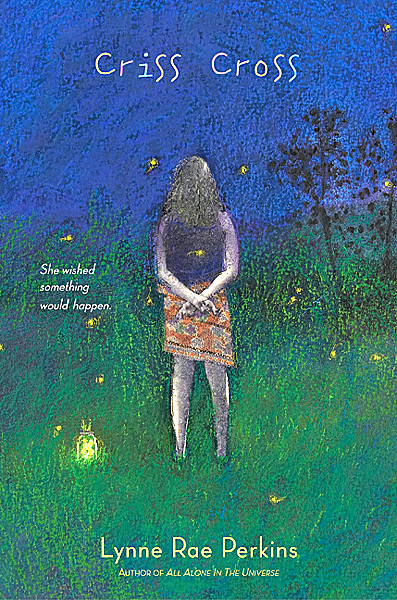
Book Review: CRISS CROSS
*NOTE: This review was created for a class at TWU.

1. BIBLIOGRAPHY:
Perkins, Lynne Rae. 2005. CRISS CROSS. New York, NY: Greenwillow Books. ISBN 0060092726

2. PLOT SUMMARY:
The Newbery Award-winning novel CRISS CROSS weaves a story of interconnected lives and moments of missed meaning. The main character, Debbie, and her group of friends all sense that they are on the verge of something, yet feel that nothing ever happens in their small world, centered around the town of Seldem. Each of them is constantly changing and growing, taking in new experiences like a sponge, especially Debbie. She learns to fix a sink, drive a stick shift, pop the clutch to start a dead battery, and stave off an elderly neighbor's diabetic episode with orange juice and sugar, and in one synchronicitous morning, she must do all of these things, leading her to also find, for three brief days, what might be love with Peter. But life goes on, her love returns to California, and Debbie and her friends connect and miss connections all over again.

3. CRITICAL ANALYSIS:
The Russian writer Marina Tsvetaeva once said that poets don't compose poetry, they just tune their inner antennae to the cosmos and let it fill them up. But the question arises, while you're tuned into the cosmos, what are you missing on earth? In much the same way, the characters in Lynn Rae Perkins' realistic young adult novel, CRISS CROSS, are, at various times, tuned into new experiences that shape their developing identities, while missing other connections that might have profoundly impacted them. The author's language, illustrations, and multi-genre format reinforce both the coming-of-age story and pondering of concepts such as fate, destiny, and man's own inability to be "tuned in" to life.

While on one level CRISS CROSS meditates upon philosophical questions of existence and the meaning of life, it is ultimately a realistic novel of growing up that bears the hallmarks of the best of today's young adult literature. First, the novel is written from the viewpoint of young people and details their struggles to become independent. Debbie, Hector and all their friends could live right down the street from any of us, and their struggles to begin to define themselves, such as changing clothes on the way to school, learning to play guitar, ditching their glasses, and letting their hair grow out, can be seen on any high school campus today. This urgent need to be different from the children their parents still saw them as is described as "cultural evolution," away from "mothers who were stranded in the backwaters of a bygone era" and who weren't "going to get it" no matter how much you argued. In her gently humorous way, Debbie resolves the problem by stating, "At some point you just had to go change your clothes in a bush."

The gentle and humorous narrative style points to another characteristic of quality young adult literature; CRISS CROSS is not didactic. The adolescents in the novel do have moments of insight and grapple with important emotions, but they stay in character, not dwelling or lecturing, but moving on to the next event in their lives. When Hector is chastised by Patty for not recognizing that girls like boys for their looks, just as boys like girls for their looks, he reflects that he "saw what she was getting at, but he didn't think it applied. He liked Meadow for her inner beauty. Which happened, in her case, to be accompanied by outer beauty. He thought her outer beauty might even be a result of her inner beauty. A time honored line of reasoning that encompasses both truth and quicksand." Hector goes on to hope his own inner beauty was visible from the outside, commenting, "I'm a hunk in my soul." The prose balances insight and humor to both address and assuage the fears and concerns that can sometimes overwhelm adolescents.

Finally, the real genius in Perkins' book lies in the way the multi-genre structure supports the story. This structural support is particularly evident in two themes: the idea that we are more or less "tuned in" to life at certain times, and the idea that although we sometimes miss connections, if those connections are meant to be made, they will be made at another time. The first concept is embodied by the term "satori," which comes from Zen Buddhism and is loosely defined as a moment of individual enlightenment. Though this concept may seem esoteric, it is made approachable in the second chapter when Hector is taken out of his usual surroundings and joins his sister in a coffeehouse to listen to music. Perkins writes, "He didn't realize he was in a sponge state but, having been separated from his moorings - couch, TV, pizza - and led into unfamiliar territory, there was a spongy piece of him left open and receptive to the universe in whatever form it might take, and the form it took was a guitar." Later, this state is described as satori, "a mystical, wordless moment of understanding about Music and Life..." and illustrated with photographs of the Civic Arena's roof opening when the weather clears, beautifully representing the abstract concept in concrete detail. Visual representation of an emotional state is exemplified in Chapter 22, "Wuthering Heights/Popular Mechanics" where the entire chapter is placed on the page in the form of two columns, the left hand column bearing Debbie's experience, and the right-hand column simultaneously describing Lenny's experience, which is frustratingly parallel, but off by moments, resulting in the two characters missing a chance to connect with one another by a paragraph.

Other states and emotions are explored through haiku, fable, script, and cartoon, creating a layered effect which belies the surface simplicity of the spare prose and, with the exception of the day Debbie saved Mrs. Bruning from a diabetic seizure, mundane events. And, ultimately, that may be the lesson to be learned from CRISS CROSS. Things are not as they appear on the surface, and missed opportunities may come again, because, although we fail to connect all the time, if we keep "tuning in" to the universe, we will connect and achieve moments of satori. Achieving individual enlightenment, however fleeting, brings us to a final characteristic of outstanding young adult literature - optimism. CRISS CROSS is optimistic. The novel ends with lightning bugs blinking their "Here I am," ready to make the next connection, achieve satori, and maybe even true love, encouraging the reader to follow nature's lead and continue to let her light shine. Taken together, the realism, depth of thought, optimism, and structural complexity of CRISS CROSS combine to create a Newbery-worthy novel.

4. REVIEW EXCERPT(S)
School Library Journal: (Starred Review) "There is a great deal of humor in this gentle story about a group of childhood friends facing the crossroads of life and how they wish to live it. Young teens will certainly relate to the self-consciousnesses and uncertainty of all of the characters, each of whom is straining toward clarity and awareness."

Booklist: (Starred Review) "...most readers will find their contemporaries in these characters. Best of all are the understated moments, often private and piercing in their authenticity, that capture intelligent, likable teens searching for signs of who they are, and who they'll become."

5. CONNECTIONS & STRATEGIES
*At the high school level, this novel could be studied in conjunction with other books or stories that call into question whether there is such a thing as "destiny" or are we simply buffeted by series of coincidental events? Is there a greater plan? In groups, students could list the "near misses" and "coincidences" in the novel, and develop an argument as to whether they think the author, Lynne Rae Perkins, is arguing that there is true love out there, and, in spite of many near misses, it will find you, or that we're all just victims of happenstance. Then, looking at it from a philosophical point-of-view, students could read some of the stories in COINCIDENCE OR DESTINY? STORIES OF SYNCHRONICITY THAT ILLUMINATE OUR LIVES (ISBN 157324824X) and take their own stand on the issue, using the stories as evidence. Or, looking at it from a "scientific" standpoint, they could read A LITTLE BOOK OF COINCIDENCE (ISBN 0802713882), which guides the reader through the solar system, pointing out beautiful patterns in nature, and leading to the question, could something so beautiful and perfect, just be chance?

* CRISS CROSS would be an excellent selection when looking at multi-genre writing. Avi's book, NOTHING BUT THE TRUTH (ISBN 038071907X) would be another good novel to use as a mentor text for multi-genre writing. Students could then try their own hand at writing about the same subject through different genres. It's an excellent way to discuss purposes for writing and point-of-view. A teacher's resource book for approaching multi-genre writing in the classroom is Tom Romano's BLENDING GENRE, ALTERING STYLE: WRITING MULTI-GENRE PAPERS (ISBN 0867094788).

Book Review: BUD, NOT BUDDY
*NOTE: This review was created for a class at TWU.

1. BIBLIOGRAPHY:
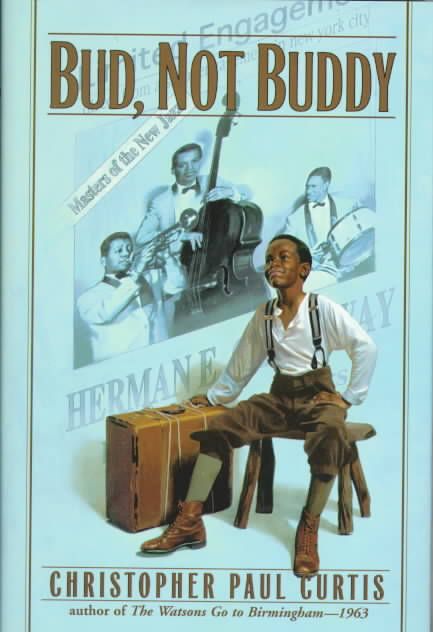
Curtis, Christopher Paul. 1999. BUD, NOT BUDDY. New York, NY: Delacorte Press. ISBN 0385323069

2. PLOT SUMMARY:
In BUD, NOT BUDDY, Newbery Award-winning author Christopher Paul Curtis tells the Depression-era story of a young orphaned boy named Bud, who runs away from an abusive foster home and goes in search of his long lost father. Along the way, he draws upon the wisdom of his mother and his own wry sense of humor to survive, befriending a ragtag bunch of musicians and finally finding a home where he belongs.

3. CRITICAL ANALYSIS:
Christopher Paul Curtis's Depression era novel, BUD, NOT BUDDY, set a high standard for young adult historical fiction by seamlessly integrating the setting with characters who are real, believable, and relevant today. The themes of dignity under desperate circumstances, courage, and hope all accurately describe the spirit of those who survived the trials and tribulations of the Great Depression in America.

First, the setting is integrated in things Bud sees, places he goes, and the conversations he has with other characters. In chapter six, when Bud waits in line for food at the "mission," he sees a sign that aptly depicts the irony of the average American's situation in "the land of milk and honey." The sign portrays a rich family of four, with "big shiny eyes and big shiny teeth and big shiny cheeks and big shiny smiles," wearing "movie star clothes," and riding in a car that "looked like it had room for eight or nine more people in it." The top of the sign reads, "There's no place like America today," to which a character jokes, "Well, you got to give them credit, you wouldn't expect that they'd have the nerve to come down here and tell the truth." Later, Bud and a friend arrive in one of the "Hooverville" tent cities, bleakly described as "a bunch of huts and shacks throwed together out of pieces of boxes and wood and cloth." Yet, once again, Curtis relieves the dark situation with humor as a woman hands the boys "plates" for their meal. Bud narrates, "a woman handed me and Bugs each a flat, square, empty tin can. 'That, m'lords, is your china. Please be careful not to chip it.' My china had the words JUMBO A&P SARDINES stamped into the bottom of it."

Second, the characters in the story are real, believable, and relevant today, especially the protagonist BUD. Just as in the thirties, 21st century children are growing up with single parents, and most people can relate to Bud's stash of sentimental objects that serve as memories of a distant relative or loved one. Anyone who has searched for someone or longed to know someone better can relate to Bud's quest to find his father. If Bud's desires and motivations are relevant, his thoughts and speech make him real and believable. Phrases such as "get holt," "kiss my wrist," and "woop, zoop, sloop," bring Bud's voice to life, and once he meets up with H.E. Calloway and the Dusky Devastators of the Depression, the boys in the band breath life into the lingo of the times with words like "chops," "scoop," "cop a squat."

While historically accurate, BUD, NOT BUDDY is most memorable for the truly charming and witty voice of its eponymous main character. Through Bud's eyes, Christopher Paul Curtis reveals the gritty realities of the Depression era, and compassionate characters whose strong doses of humor help everyone to keep hope alive and survive one of the worst periods in our country's history. This was my second reading of this outstanding novel, and even though I knew how it ended, I still found myself crying right along with Bud when I got to Chapter 14.

4. REVIEW EXCERPT(S)
Children's Literature: "Curtis' book follows a young African-American boy as he struggles to find a home during the Depression. The author takes on a difficult time and seemingly sad plot, but Bud, the hero, has humor and originality that will open new doors and understanding about this era."

Publisher's Weekly: "As in his Newbery Honor-winning debut, The Watsons Go to Birmingham--1963, Curtis draws on a remarkable and disarming mix of comedy and pathos, this time to describe the travails and adventures of a 10-year-old African-American orphan in Depression-era Michigan."

5. CONNECTIONS & STRATEGIES
*Create a "Frozen Tableau" to help students better understand what it was like to live during the Depression. Give students copies of Depression Era photographs (perhaps the work of Dorothea Lange) and have students journal to react to them. In a discussion forum, clear up any misconceptions or confusion the pictures may have engendered. Then in groups, students pose as people in one of the pictures, creating a "frozen tableau." While in their frozen poses, the students answer questions from the teacher who acts as a "reporter," wanting to know the more about the people, the times, and the emotions in the picture. Use the instructions for creating a "Frozen Tableau" for THE WATSONS GO TO BIRMINGHAM as a guide. They can be accessed at: http://www.learner.org/channel/workshops/tml/workshop5/authors1b.html

* Compare and contrast the protagonists in A SINGLE SHARD (ISBN 044041581) and BUD, NOT BUDDY. Both novels tell the story of young orphaned boys trying to find their home in the world. I was struck by the similarities in the "wisdom" imparted to them by loved ones which each carried within them as a source of strength. Students could reflect on words of wisdom their own family and mentors may have imparted and write a short autobiographical narrative interweaving those words into the story.

Book Review: THE MIDWIFE'S APPRENTICE
*NOTE: This review was created for a class at TWU.
*Illustration by young artist from: www.dbrl.org/outreach/book-cover/03/

1. BIBLIOGRAPHY:
Cushman, Karen. 1995. THE MIDWIFE'S APPRENTICE. New York, NY: Clarion Books. ISBN 0395692296.

2. PLOT SUMMARY:
The Newbery Award-winning novel A MIDWIFE'S APPRENTICE weaves the coming-of-age tale of a young orphan girl, cruelly nicknamed "Dung Beetle" and "Brat," who, through hard work and perseverance, becomes a capable young woman, Alyce. Wanting only "a full belly, a contented heart, and a place in this world," Alyce suffers ostracism, disappointments, and crisis of faith in herself before coming to realize that her place in the world is as a midwife's apprentice, and her family is what she makes it: a bitter midwife, a stray cat, and a village full of characters.

3. CRITICAL ANALYSIS:
The hallmarks of good historical fiction include that the history is accurate, it isn't sugar-coated, it is seen through the eyes of a young protagonist, it comes to life through the patterns of daily life, and it isn't revealed through too much historical detail. Karen Cushman's novel A MIDWIFE'S APPRENTICE contains all these hallmarks along with a wonderful girl's coming-of-age story.

There can be no doubt that history isn't sugar-coated when a novel starts with the line, "When animal droppings and garbage and spoiled straw are piled up in a great heap, the rotting and moiling give forth heat. Usually no one gets close enough to notice because of the stench." In fact, most of the settings in THE MIDWIFE'S APPRENTICE reveal that medieval life didn't really resemble the Hollywood "knight saves princess" tales we've all come to love. No, in this story, boys torment cats, husbands cheat on wives, making soap stinks up the whole yard, and our young protagonist, Alyce, doesn't take a bath until 3/4 of the way through the plot!

If life is less than rosy, it is even more so through the eyes of the orphan girl known as Brat, Dung Beetle, and finally Alyce. While she begins the story with only an empty belly and hard experiences, her keen curiosity and perseverance leads her to a happy existence as the midwife's apprentice and allows the reader to soak in all the details of village life. Through her eyes, we learn that "columbine seeds speed birth" and cobwebs are used for "stanching blood," we see "pennants flying...copper kettles, rubies and pearls, ivory tusks from mysterious animals," and "pies stuffed with pork and raisins," at the market in Gobnet-Under-Green, and we feel the "stiff vellum" used by Master Reese to write his great encyclopedia. Because Alyce is so inquisitive by nature, these historically correct descriptions never feel unnatural, but rather is a natural extension of the daily patterns she experiences.

Only one section of the novel seemed less than realistic to me, and that was the chapter entitled "The Devil." While I enjoyed the descriptions of medieval superstitions, I had difficulty believing that Alyce, working most of the day as the midwife's apprentice, and having no real skills as a woodworker (even though it does mention she likes to watch the woodworker at work), would be able to carve two blocks to look like animal prints. Even if she could do that, how would she be able to use them to create a trail that led to someone committing an evil deed without also leaving footprints and/or being detected. And what are the chances that the townspeople would catch the culprits in the act every time? It just seemed far-fetched to me.

Yet the rest of the novel is delightfully fast-paced, and keeps a nice balance of historical detail and action. Karen Cushman works wonders with characterization, describing Jane the midwife as "a woman neither old nor young but in between. Neither fat nor thin but in between. An important-looking woman, with a sharp nose and a sharp glance and a whimple starched into sharp pleats." Other, more minor characters are characterized with similar care. Joan, the bailiff's wife, "washed her linen each week and never let herself be seen even in summer," and Master Reese was "long and skinny as a heron, with black eyes in a face that looked sad, hungry, and cold."

Like many young adult novels, THE MIDWIFE'S APPRENTICE is a bildungsroman of self-discovery, but Cushman avoids a Disney-like ending by foregoing hugs and happy reunions which would ring false in the difficult times of fourteenth-century England, and opting for a simpler closure. When Alyce finally regains the courage to return to the midwife after disgrace and ask to be an apprentice again, she is initially rejected, but perseveres, refusing to leave the midwife's front step, setting up the final scene: "The door opened. Alyce went in. And the cat went with her." We are left to speculate whether Alyce would grow up, become an even better midwife due to her caring heart, and fall in love with the local red-haired boy.

Delightful characterization, fascinating details, and a charming protagonist, make THE MIDWIFE'S APPRENTICE an enjoyable story for those who love medieval times, Chaucerian foibles, and spunky protagonists.

4. REVIEW EXCERPTS:

From School Library Journal: "Characters are sketched briefly but with telling, witty detail, and the very scents and sounds of the land and people's occupations fill each page as Alyce comes of age and heart. Earthy humor, the foibles of humans both high and low, and a fascinating mix of superstition and genuinely helpful herbal remedies attached to childbirth make this a truly delightful introduction to a world seldom seen in children's literature."

From Booklist: "The characters are drawn with zest and affection but no false reverence... Kids will like this short, fast-paced narrative about a hero who discovers that she's not ugly or stupid or alone."

5. CONNECTIONS
* Students could use THE MIDWIFE'S APPRENTICE as an introduction to a medieval unit in 6th grade social studies. After reading the novel, the class could split into groups, each taking a different village building (midwife's cottage, farm, woodworking shop, mill, tavern, manor) and research what it would look like an what it would contain. Then each group could create a three-dimensional model of the building, labeling important areas/items. After presentations, the buildings could be arranged to create an entire medieval village.
* Use in a girls' book club and compare to A DAUGHTER OF VENICE by Donna Jo Napoli (ISBN 0440229286) and TRUE CONFESSIONS OF CHARLOTTE DOYLE (ISBN 0380782550) by AVI. All three novels are historical, deal with a girl's coming of age, and the stereotypes and constraints put upon women during the time in which they lived. Discussions could center around the treatment of girls and women throughout cultures and history.

Book Review: A SINGLE SHARD
*NOTE: This blog was created as part of a class at TWU.

1. BIBLIOGRAPHY:
Park, Linda Sue. 2001. A SINGLE SHARD. New York, NY: Dell Yearling. ISBN 0440418518

2. PLOT SUMMARY: Set in 12th century Korea, the Newbery Award winning novel A SINGLE SHARD tells the tale of 12-year-old orphan Tree-ear, who lives under a bridge with the wise but crippled old Crane-man. Longing to become a potter himself, Tree-ear begins to work for a master celadon maker, Min, and through adventures not only garners Min a royal commission, but gains courage, a home, and a future as an artist.

3. CRITICAL ANALYSIS:
As historical fiction goes, A SINGLE SHARD has all the elements to envelope readers in another time and buoy them through the events in young Tree-ear's life, while glimpsing accurate views of another place and time. The setting, 12th century Korea, is integral to the plot, the characters are vividly drawn and believable, and the plot and theme are realistic to the time period and yet touch upon issues relevant today.

The setting in this bittersweet novel of hope and courage influences every aspect of the story, yet is integrated into the story subtly. From the very first lines, when Tree-ear's mentor, Crane-man, humorously twists the traditional greeting of "Have you eaten well? ("Shik Sa Ha Syeoss Ship Nee Ka?") to "Have you hungered well?" Linda Sue Park breathes life into the setting through the character's speech, their conduct towards one another, details of everyday events, and descriptions of the places in the novel. The young protagonist is an orphan, and as such, on the lowest level village society. After being apprenticed by a local master potter, Tree-ear is fed by the potter's wife, and treats her with such respect that he rarely speaks and does not dare to look at her but keeps his head bowed. When the wife gives him winter clothes, Tree-ear expresses his thanks by saying, "Deepest gratitude to the honorable potter's wife." Throughout the book, this level of respect and sense of place in society permeates the characters' dialogue and actions, sustaining the historical setting. Everyday details further strengthen the sense of time and place. Tree-ear sees a man on the road carrying a jiggeh, which is then briefly described as "an open-framed backpack made of branches," revealing the simplicity and ingenuity of the times, and later watches the potter Min make a prunus vase, introducing the reader to the Korean art of flower arranging and artistic esthetic: "It would be a prunus vase - the most elegant of all the shapes. Tall and beautifully proportioned, rising from its base to flare gracefully and the round to the mouth, a prunus vase was designed for one purpose - to display a single branch of flowering plum." All the descriptions of the steps involved in making the village's famous celadon ware are fascinatingly detailed and accurate, from the digging of the clay, to the mixing of the slip, and the firing process. Finally, the physical details of the village, and the towns, mountains, and valleys Tree-ear passes through on his way to the capital, Songdo, are captivatingly described with the innocence and wonder of a 13-year-old. The marketplace in the town of Puyo is especially vibrant, with each stall holding a wonder of items for every taste and desire. "The onggi seller's stall displayed every size of vessel," writes Park, "from tiny sauce dishes to kimchee jars big enough for a man to stand hidden within."

Park spares no descriptive talent on the characters, either. Crane-man's spirit of life and sense of humor shines through in spite of his deformity, Min's tender heart is revealed beneath his exacting nature and gruff exterior, and Tree-ear's transformation from child with a sliver of hope, to young man with confidence and a vision for his future unfurls before the reader's eyes. Near the end of the story, Tree-ear has his defining moment after being set upon by robbers and having his precious cargo, two of Min's pots, smashed on a cliff below him. The author writes, "Tree-ear rolled onto his side and vomited. He retched again and again, until his stomach felt as empty as his spirit...Failure. The most dishonorable failure. He had been unable to keep the vases safe." Yet Tree-ear does not give up, and "suddenly, a last flicker of hope flared within him. The second vase - he had not heard the crash. Perhaps it had fallen into the water, perhaps it was still unbroken." Although he finds only a single shard, a single sliver of hope, Tree-ear musters the courage to continue his journey and present just that piece to the king's emissary. Ultimately, Tree-ear is successful and although his return is bittersweet due to Crane-man's death, he becomes part of Min's family and a true potter's apprentice.

The plot and theme in A SINGLE SHARD is appropriate for 12th century Korea, revolving around questions of honesty, respect, and courage, and yet are relevant today. First, Tree-ear's struggle to find and define himself, to figure out where he belongs, is one that adolescents make every day. Second, although very respectful, Tree-ear often feels shame and resentment when he feels that he has been treated unjustly, although he realizes later that learning things the hard way is often the best way. And finally, he learns that "leaping into death is not the only way to show courage," by persevering and having the courage to go into the palace with only a single shard to show the king's emissary. Students today often view courage as something from the realm of video games and graphic novels, and the wisdom of Crane-man could help them to understand that courage isn't always visible, but comes from inside and is drawn upon everyday by almost everyone.

Throughout A SINGLE SHARD, Linda Sue Park inlays the stories and maxims of Crane-man, creating a well of wisdom from which Tree-ear dips to nourish and strengthen himself on his long journey. These stories, like the descriptions of pottery-making are never intrusive, and lend a uniqueness and subtlety to the novel which would enchant most readers, and pique the curiosity of many about the ancient culture of Korea.

In an author's note Park explains the historical basis for the characters and events, telling where vases such as the ones described in the novel can be found. (I almost booked a flight to Seoul!) She also describes the changes in Korea's history since the 12th century, and that fact that several locations in the book remain, but under different names. My edition of the novel also included an afterword, "What's So Special About Celadon" and an interview with the author.

4. REVIEW EXCERPTS:
From Publisher's Weekly: "Park (Seesaw Girl) molds a moving tribute to perseverance and creativity in this finely etched novel set in mid- to late 12th-century Korea...Readers will not soon forget these characters or their sacrifices. Ages 10-14."

From Booklist: "This quiet, but involving, story draws readers into a very different time and place. Though the society has its own conventions, the hearts and minds and stomachs of the characters are not so far removed from those of people today. Readers will feel the hunger and cold that Tree-ear experiences, as well as his shame, fear, gratitude, and love. A well-crafted novel with an unusual setting."

5. CONNECTIONS
* This novel would be an excellent read for 6th grade in Texas, to complement the World History focus of 6th grade social studies. After reading the book, local potters could be invited to the school to give a demonstration and allow students to try their hands at throwing a pot, or student could take a field trip to a museum to view celadon pottery up close and in person.
* Chapter 11, where Tree-ear is robbed and the vases are smashed, and Chapter 12, where he meets with the royal emissary would be good sections for students to adapt into a Reader's Theater script and act out.
* Read THE YEAR OF IMPOSSIBLE GOODBYES by Sook Nyul Choi (ISBN 0440407591) which takes place in war-time Korea and details the harrowing trek a young girl and her family must make to escape the Communists in the aftermath of the war. Comparing the two protagonists would be a great springboard to a discussion of courage and perseverance, allowing the students' to connect to their own lives, while deepening their understanding of Korean history. It might also be interesting to create maps of the journeys each character takes and see where they might intersect.

Book Review: AN AMERICAN PLAGUE
NOTE: This book review was created for a class at TWU
1. BIBLIOGRAPHY:
Murphy, Jim. 2003. AN AMERICAN PLAGUE. New York, NY: Clarion Books. ISBN 0395776082

2. PLOT SUMMARY:
AN AMERICAN PLAGUE tells the story of the Philadelphia Yellow Fever epidemic of 1793, from the very first days in August, before the citizens of the city of brotherly love realized that a dreaded disease was in their midst, to the late October days of the city's recovery. The story is told in narrative style through the eyes of the citizens who suffered, died, or survived. The final two chapters are devoted to the history of changes in the plague's aftermath, to the discovery of yellow fever's carrier, the mosquito in the early 1900s.

3. CRITICAL ANALYSIS:

For many students, just the thought of reading a non-fiction title about early American history can cause symptoms similar to those described in AN AMERICAN PLAGUE. Said pupil, when confronted by such a task may feel feverish, "depressed, confused, and delirious." Yet even the most non-fictionophobic reader would find his or her aversion to informational texts disappear by the end of the first paragraph of Jim Murphy's wonderful retelling of the events during the Philadelphia yellow fever epidemic of 1793.

Although the book is highly accurate and meticulously researched and documented, AN AMERICAN PLAGUE reads like a historical mystery novel. Witness the following excerpts from the first page: "Saturday, August 3, 1793. The sun came up, as it had every day since the end of May, bright, hot, and unrelenting. The swamps and marshes south of Philadelphia had already lost a great deal of water...Dead fish and gooey vegetable matter exposed and rotted...Mosquitoes were everywhere, though their high pitched whirring was particularly loud near rain barrels, gutters, and open sewers." The book begins like a journal entry, and within a few short lines, the reader is immersed in the time period and setting. Murphy has even introduced the prime suspect in the mystery - the mosquito.

Once the reader has been drawn in to his tale, the author then supplies fascinating facts, explaining the 18th century sewer system that used open gutters and "sinks" to remove waste, and describing in vivid detail the symptoms of the yellow fever victim. Accompanying the text throughout the book are engravings, excerpts from newspapers, maps, advertisements, cartoons, and portraits.

Accuracy is not sacrificed for imagery, however, and Murphy uses precise language where needed. He describes the last stage of the yellow fever patient thusly, "The skin and eyeballs turned yellow, as red blood cells were destroyed, causing the bile pigment bilirubin to accumulate in the body; nose, gums, and intestines began bleeding; and the patient vomited stale, black blood." If the author had "dumbed-down" the description and left it at "The patient vomited black blood," it would not only be less informative, but less interesting as well.

Each chapter of AN AMERICAN PLAGUE begins with a similar journal-like entry, building upon a cast of characters, from Dr. Rush, whose early warnings were ignored, to Reverend Helmuth, who visited stricken patients throughout the city. Murphy's narrative is interspersed with quotes from such eyewitnesses, providing not only fascinating details, but also different perspectives on those terrible months in 1793.

Throughout the book, the questions of what caused the yellow fever, how it spread, and how another epidemic could be prevented, flow beneath the unfolding events. Like Philadelphia citizen Dr. Rush, the reader looks for clues in every eyewitness's story, until finally, at the end of the book, Murphy narrates how, in the early 1900s, doctors discovered that yellow fever was a mosquito borne virus. The mystery solved, it still took almost 40 years to come up with a vaccine, and many more years to make government changes to help prevent another epidemic. Indeed, AN AMERICAN PLAGUE brings us almost up to the present, connecting real world current health threats with the yellow fever threat of over 200 years ago.

AN AMERICAN PLAGUE has won numerous awards, including the Robert F. Sibert Award for outstanding non-fiction. Like all of Jim Murphy's books, it was born out of his curiosity and developed through research into a wonderful narrative about a terrible disaster. In his acceptance speech for the Horn Book Award, Murphy said that, "Writing about any disaster provides a natural story line with a beginning, middle, and end, but readers deserve more. Broader historical issues, odd and intriguing characters, and humor, to name a few." In AN AMERICAN PLAGUE Murphy provides everything the readers deserve, including the cure for non-fictionophobia.

4. REVIEW EXCERPT(S)
School Library Journal: "Black-and-white reproductions of period art, coupled with chapter headings that face full-page copies of newspaper articles of the time, help bring this dreadful episode to life. An afterword explains the yellow fever phenomenon, its causes, and contemporary outbreaks, and source notes are extensive and interesting. Pair this work with Laurie Halse Anderson's wonderful novel Fever 1793 (S & S, 2000) and you'll have students hooked on history."

Booklist: "History, science, politics, and public health come together in this dramatic account of the disastrous yellow fever epidemic that hit the nation's capital more than 200 years ago. Drawing on firsthand accounts, medical and non-medical, Murphy re-creates the fear and panic in the infected city, the social conditions that caused the disease to spread, and the arguments about causes and cures."

5. CONNECTIONS
*Science: After reading AN AMERICAN PLAGUE, students could tackle questions of world health and mosquito-borne diseases such as yellow fever, malaria, and the West Nile virus. Students could watch program four "Deadly Messengers" of PBS's award-winning series "Rx for Survival" and role play how disease spreads. Following the role play, students brainstorm ways to halt the spread of disease in a global economy. Use the lesson that accompanies the program for guidance: http://www.pbs.org/wgbh/rxforsurvival/series/teachers/pdf/rx_guide_messengers.pdf

*Language Arts/US History: Use exerpts from AN AMERICAN PLAGUE along with selections from Laurie Halse Anderson's novel FEVER 1793 (ISBN 0689848919), parts of the recently published treatise on how yellow fever could be used as a biological weapon, entitled YELLOW FEVER: A DEADLY DISEASE POISED TO KILL AGAIN (ISBN 1591023998) by James Dickerson, Henry Wadsworth Longfellow's "Evangeline," Phillip Freneau's short poem "Pestilence" written in 1793 (http://xroads.virginia.edu/~MA96/forrest/WW/feverlit.html), and "Ye Heroes of Ye Epidemic" a long narrative poem written about a Florida yellow fever epidemic in 1888 (http://fulltext10.fcla.edu/DLData/NF/NF00000039/file2.pdf), to learn more about America's early history, and about how one topic, yellow fever, can be described from different points of view and for different purposes. Students could then research another event in early American history, such as the Salem Witch Trials, and try their hand at writing a nonfiction chapter, a short story, poetry, or a modern day take on that event.
* Jim Murphy's acceptance speech for the Horn Book Award is hilarious and enlightening. It would be a wonderful way to begin a discussion of how to write nonfiction and/or what it means to be a writer. The transcript can be found at: http://www.hbook.com/publications/magazine/articles/jan05_murphy.asp

Book Review: LINCOLN: A PHOTOBIOGRAPHY
*NOTE: This review has been created for a class at TWU.
Image courtesy of: http://www.amazon.com

1. BIBLIOGRAPHY:
Freedman, Russell. 1987. LINCOLN: A PHOTOBIOGRAPHY. New York, NY: Clarion Books. ISBN 0899193803

2. PLOT SUMMARY:
U.S. President Abraham Lincoln's biography is told in both pictures and words by Russell Freedman in LINCOLN: A PHOTOBIOGRAPHY. In seven chapters, Freedman details Lincoln's life, beginning with a general introduction discussing how Lincoln's image was captured by both those who knew him and modern day historians, and how we are still fascinated by the president who is now "admired as a folk hero." Using photographs, drawings, primary documents, and text, Freedman describes Lincoln from childhood to his death. The end of LINCOLN: A PHOTOBIOGRAPHY contains a section of quotes by the great man, a travel itinerary for those interested in following in his footsteps, a resource list of books about Lincoln, and a detailed index for easy reference.

3. CRITICAL ANALYSIS:
Accuracy is the most important criterion in judging a nonfiction title, and Russell Freedman's "photobiography" of Abraham Lincoln is both meticulously researched and highly accurate. Freedman has written over 50 books for young people, and LINCOLN: A PHOTOBIOGRAPHY is a Newbery Medal winner. In researching Lincoln's life, Freedman traveled in Lincoln's footsteps, gathering information from experts on Lincoln's life and work from around the United States. As a bonus for readers, the author shares his sources in the Acknowledgements section at the back of the book, along with a list of books about Lincoln with reading suggestions. Freedman also includes a list of historic sites that "played an important part in Lincoln's life, career, and death." The list includes a description and contact information so that we, too, can "walk in Lincoln's footsteps."

Yet accuracy is just scratches the surface of what LINCOLN: A PHOTOBIOGRAPHY has to offer. Apart from the first chapter, the book is organized in chronological order, beginning with Lincoln's birth and childhood, and ending with the President's untimely death. The first chapter, however, really grabs the reader's attention. Entitled "The Mysterious Mr. Lincoln," this chapter not only gives a short history of how Lincoln was viewed during his day up to the present noting the elusiveness of both man and myth, and clearly showing Freedman's passion for his subject matter. "Abraham Lincoln wasn't the sort of man who could lose himself in a crowd," writes the author, "After all, he stood six feet four inches tall, and to top it off, he wore a high silk hat."

Throughout the rest of the biography, Freedman uses a variety of techniques to engage the reader. In Chapter Two, lively comparisons evoke vivid images of Lincoln as a child. He is described as "a tall spider of a boy," growing fast and "shooting up like a sunflower." Later in the chapter, well-quotes from Lincoln's relatives further enhance the description, and the use of dialect puts the reader right into the time and place of Lincoln's childhood. The author quotes a cousin who describes Lincoln as "the gangliest awkwardest feller," who "would carry a book out to the field with him, so he could read at the end of each plow furrow, while the horse was getting its breath." Quotes are used again with great effect in the final chapter of Lincoln's life entitled, "Who is Dead in the White House?" Here, Freedman quotes Lincoln himself, saying, "I long ago made up my mind that if anyone wants to kill me, he will do it. If I wore a shirt of mail, and kept myself surrounded by a bodyguard, it would be all the same. There are a thousand ways of getting at a man if it is desired that he should be killed."

In other parts of LINCOLN: A PHOTOBIOGRAPHY, the attractive design engages the reader. As the author mentions in the first chapter, Lincoln was the most photographed man of his time, but Freedman doesn't simply sprinkle his text with photographs. Instead, he puts them in thought-provoking compositions, as in Chapter Four, where, along the bottom of the two-page spread, four photos of Lincoln from late 1860 to early 1861 show his transformation by growing a beard. The progression is both intriguing and humanizing. Photographs are not, however, the only type of visual element used in the book. Text is accompanied by manuscripts, engravings, and political cartoons. In Chapter Five, a political cartoon ridiculing Lincoln's clandestine arrival in Washington illustrates the following anecdotal description: "Word of Lincoln's secret night ride spread fast...They taunted him Lincoln as a hick with a high-pitched voice and a Kentucky twang, an ugly gorilla and baboon."

Finally, Freedman fills his "photobiography" with fascinating facts so numerous, there isn't space to list them all here, but one that sticks in this reader's mind is the fact that Lincoln had a house full of pets, including a goat, which slept on his son Tad's bed. Taken in total, all these techniques, the use of quotes, a variety of visual elements, the inclusion of anecdotes, fascinating facts, and lively comparisons, combine to create a biography of a great man that is engaging, thought-provoking, and humanizing. LINCOLN: A PHOTOBIOGRAPHY sets the bar high for juvenile biographies and works of non-fiction.


4. REVIEW EXCERPT(S)
Booklist Editor's Choice: "A realistic, perceptive, and unromanticized photobiography of Lincoln, including a sampler of quotations from his writings and speeches."

School Library Journal: "Well-organized and well-written, this is an outstanding example of what (juvenile) biography can be. Like Lincoln himself, it stands head and shoulders above its competition."

5. CONNECTIONS
*Explore Lincoln's life and times further with the aid of the PBS series "The American Experience." Compare and contrast the video documentary "Abraham and Mary Lincoln: A House Divided" with Freedman's book. Lesson plans to go with the film can be found at: http://www.pbs.org/wgbh/amex/lincolns/tguide/index.html

*LINCOLN: A PHOTOBIOGRAPHY is a great mentor text for students writing biographies of role models in their lives. Using it, along with other great biographies such as DARE TO DREAM: 25 EXTRAORDINARY LIVES (ISBN 1591022800) by Sandra McLeod Murphy, which offers engaging, short sketches easily accessible to reluctant readers and THE MAN WHO MADE TIME TRAVEL (ISBN 0374347883) written by Kathryn Lasky and illustrated by Kevin Hawkes, which exemplifies how to create a picture book biography, students can gather information on someone in their lives whom they admire to create their own biographical sketches. A starting point might be the list of monthly character traits used in many schools. Students could brainstorm people they know who share each character trait. Then, in mini-lessons, the teacher could demonstrate the craft of "showing, not telling" in writing. Students could then narrow their topic down to one character trait and role model, choosing someone whom they could interview. After conducting interviews with the role model and those who know the role models, students create either a "photobiography," biographical sketch, or picture book biography. Once the biography projects are complete, students invite the role models to a reading and present the projects to the role model as a gift. At Taylor Middle School, we do this project every year in December with the 7th grade students, and it is motivating for the students and memorable for the role models.

Book Review: AUTUMN ACROSS AMERICA
*Note: This book review was created for a class at TWU.
Photograph courtesy of www.mooseyscountrygarden.com

1. BIBLIOGRAPHY:
Simon, Seymour. 1993. AUTUMN ACROSS AMERICA. New York, NY: Hyperion Books for Children. ISBN 0152163956

2. PLOT SUMMARY:
Author Seymour Simon takes the reader on a photographic journey across America in autumn while describing the scientific reasons for the season, along with its effects on flora, fauna, and man in this informational trade picture book. Beginning with a description of autumn's beauty, continuing with information about why the seasons change, why leaves change colors and fall, why animals migrate, how the season affects insects, how plants distribute seeds during the autumn, and how the season differs in each region of America, the book ends as it began, with a description of autumn's beauty and meaning for the Earth.

3. CRITICAL ANALYSIS:
Although AUTUMN ACROSS AMERICA was written more than 10 years ago, it contains many of the qualities that have come to define engaging informational picture books in recent years. The book's design is very attractive, with a beautiful mix of text and photography that draws the reader from page to page, alternating breathtaking landscape shots of trees, country roads, and mountains, with close-ups of fallen leaves, unusual insects, and pumpkins. The most striking picture is that of the lowly milkweed, releasing its seeds like a miniature fireworks display. The text accompanying the milkweed picture intertwines in-depth factual information such as "Seeds...contain an embryo, or young plant, and a supply of food," with more lyrical descriptions of how the seeds are scattered. "When a pod splits open in October," writes Simon, "only a few seeds at a time are released. Their silken parachutes catch the faintest breeze, and they sail off to unknown destinations." Such compelling details, and little known facts, as in the section on the monarch butterfly, which flies "from ten to 15 miles per hour, traveling eighty miles or more a day," are enhanced with fascinating comparisons. Seeds are "travelers" "hitchhiking" and aspens are a "slash of golden light" amid the green of fir trees. While the colorful subject matter will appeal to younger readers, Simon does not "dumb down" the vocabulary, using scientific terms that will inform older readers as well. For this reader, who quickly tires of theories, facts, and figures, AUTUMN ACROSS AMERICA was a refreshing and eye-catching change, and a reminder that the seasons both inspire poetry and serve nature's purposes.

4. REVIEW EXCERPT(S)
School Library Journal: "Since there is no index and no table of contents, children looking for specific information will be frustrated. The book's main attraction is its design-beautiful photographs set in pages of glowing fall colors... Seasonal materials are always in demand; this one is a good choice for browsers."

Booklist: "Simon's first book in a series about the changing seasons introduces autumn as a 'season of memory and change.' By the book's end, readers will grasp the significance of that phrase. Throughout this tribute, each double-page spread contains at least one, sometimes two, four-color photographs of a typical fall scene opposite two or three paragraphs of Simon's information-packed text, all appearing on a brilliant background color. This makes each turn of the page a delightful shock, not unlike the astonishment of seeing the first orange tree of fall."

5. CONNECTIONS
*Use this book with others about how foliage changes such as Sylvia Johnson's HOW LEAVES CHANGE (ISBN 0822595133) and AUTUMN LEAVES (ISBN 0590298798) by Ken Robbins to support students in creating an observation notebook of changes in foliage in their own neighborhood. This could help to teach the scientific method, descriptive writing, or, in combination with students' photographs, become the basis of a photo essay. Other activities connecting to fall foliage and photosynthesis can be found on EducationWorld at: http://www.educationworld.com/a_lesson/lesson/lesson024.shtml
* Using Simon's format as a model, older students in World Geography could write their own "Autumn Across _____________" children's book, choosing different countries, continents, or regions of the world. Students could then present the books and discuss similarities and differences in the season around the world.
*Read "Autumn Across America" and other nonfiction titles about the seasons in conjunction with selected poems from POETRY FOR YOUNG PEOPLE: SEASONS (ISBN 1402712545) to inspire seasonal poetry writing.

Book Review: WHAT IS GOODBYE?
*NOTE: This book review was created for a class at TWU.

1. BIBLIOGRAPHY:
Grimes, Nikki. 2004. WHAT IS GOODBYE? Ill. by Raul Colon. New York, NY: Hyperion Books for Children. ISBN 0786807784

2. PLOT SUMMARY:
WHAT IS GOODBYE? is a book of narrative poems in the two voices of a brother and sister, Jerilyn and Jesse. In the space of a little more than a year, each works through shock, pain, sorrow, remembering, healing, and moving on after the death of their older brother Jaron. The poems illustrate the different ways the two cope with their brother's death and with the reaction their parents have to his death. Although the family appears to have been irreparably torn apart by the tragedy, time heals, and the book ends with the family unified again.

3. CRITICAL ANALYSIS:
Nikki Grimes and Raul Colon collaborate to handle tough issues surrounding dealing with the death of a close relative. Although the book is somber, the poems of Jerilyn and Jesse, written in distinctly different styles to reflect the children's different voices, detail the stages of grief beautifully. Beginning with hearing the news of Jaron's death, the brother and sister react similarly, but express their shock differently. Jesse's simple rhymed lines reflect his younger age and temperament: "My ears aren't working./My hearing's broke./Mom's lips are moving./Is this some joke?" In contrast, Jerilyn's unrhymed verse is filled with similes and metaphors such as "Daddy told me in a whisper/sharp as a switchblade," and "Mommy also hid/her eyes dull coins/peeking from the pockets/of her lids."

Recalling the death of my own grandfather when I was young, I could immediately identify with shock, numbness, and then anger in the days following his death. In particular, I remember being upset that I was supposed to play with all the relatives who had come over after the funeral, when all I wanted was for them to leave so I could walk through the house remembering all the little things he used to do. Just like Jerilyn, who reflects,

"I wander through this
silly crowd, wondering why
no one tells the truth.
Dead is dead.
Not "gone away."
Not "lost."
Not "passed" - as if
my brother's life
were some test
he got a good grade on,
and now he's gone.

I didn't understand all the euphemisms that were meant to ease the hollowness I felt inside. In many parts of the novella, Jerilyn and Jesse react differently, Jesse acting out, and Jerilyn turning inward, but their closeness as siblings is poignantly revealed in the poems entitled "First Fear" which are placed together on the page, intensifying the sense that they occur simultaneously. Jerilyn observing, "Look at him/head buried/in the black cushion/of Lucky's coat,/tears raw as rain," while Jesse worries, "Me and Lucky/two of a kind./Boy and dog whimpering./Does Jeri mind?" The poem ends with the two hugging, beautifully illustrated by Colon, whose details such as the eye pattern on the wallpaper visually illustrates the inner landscape of the children, who feel like everyone is watching them to see if they will crumble under the grief.

This inner landscape is revealed in Colon's lithographic illustration which accompanies Jerilyn's version of "Rush" In the poem, the girl wants her mother to hurry up and return to the way she was before Jaron died, and in particular, yearns for the closeness she felt with her mother when "...we were/holding hands/the way we used to." To illustrate this, Colon depicts mother and daughter, dressed identically, each sitting in an upper right hand corner of the picture, hands clasped on the lap. An inset between them shows the daughter's and mother's hands reaching to hold one another. In an exquisite detail, the pattern on the carpet at their feet has keyholes, symbolizing that holding hands is, in Jerilyn's mind, a key to regaining her relationship with her mother.

Both children grow as time passes, and Jesse's poems become more complex, incorporating more imagery, similes, and metaphors, as when he says, "Folks wind my sadness like a clock." The children mature, are able to simply enjoy a day, mend the relationships with their parents, and learn to love the memories of Jaron each both hold dear. Jerilyn comes to an understanding that this loss has made her appreciate her own life more, too. She writes,

Ordinary days
are golden,
like ancient coins
recovered from
a treasure hunt.
More of them is
what I want
now that I've learned
to spend
or save each one
as if
it matters.

In the end, both speak together in the poem for two voices "Photograph." The family is unified in taking a portrait, and the poetic form reflects that. WHAT IS GOODBYE? touchingly illustrates both how to approach a difficult topic, and how form can enhance and enrich function. I wish I had had this novella in verse to help me through my grief when my grandfather died.


4. REVIEW EXCERPT(S)
Booklist: "In poems that alternate between voices, Jerilyn and Jesse describe their complicated, private thoughts as they grieve for their beloved brother."

School Library Journal: "Grade 3-8–Grimes's novella in verse is a prime example of how poetry and story can be combined to extend one another."

5. CONNECTIONS
*This book may help teachers and librarians broach a difficult subject such as death. Other books for children dealing with death can be found at: http://www.barrharris.org/barbooks.html#For
*Explore other books written in two voices, such as Paul Fleischman's classics JOYFUL NOISE (ISBN 0064460932), and Jim Harrison's FARMER'S GARDEN (ISBN 1590781775)
*Use the two voices in the story to discuss both voice and point of view, then try writing two-voice poetry using readwritethink.org's lesson plan at http://www.readwritethink.org/lesson_images/lesson391/two-voice.pdf

Book Review: BOW WOW MEOW MEOW

1. BIBLIOGRAPHY:
Florian, Douglas. 2003. BOW WOW MEOW MEOW. Ill. by Douglas Florian. New York, NY: Scholastic, Inc. ISBN 0152163956

2. PLOT SUMMARY:
In this beautifully illustrated picture book, Douglas Florian presents 21 poems, 11 about dogs of all breeds and sizes, and 10 about cats from domesticated to wild. The poems are thoughtful and humorous. Each selection is short and could be read aloud. The target audience for this book is age 4-8.

3. CRITICAL ANALYSIS:
I wonder if author Douglas Florian is playing favorites by writing 11 poems about dogs and only 10 about cats in his funny and insightful picture book entitled, BOW WOW MEOW MEOW. One thing is for sure, Florian doesn't play favorites with poetic form. The poems run the gamut from long strings of rhymed couplet as in "Cat Chat" to concrete poems of pure fun as in the curly poem-shapes in "The Poodles," to poems of haiku-like simplicity, as in "The Manx."

Who always yanks
The tail off the Manx?

Florian's play with poetic form is accompanied by plays on words, playful sounds, fanciful images, and surprising poetic turns. BOW WOW MEOW MEOW shows a definite penchant for puns, describing the bloodhound as "Scent-sational" and the jaguarundi as wearing "jaguarundi-wear." Playful sounds abound, too, with the Chihuahua barking "Chi-hua! hua! hua! hua! hua! hua! hua!" and the Persian cooing about its "purrrrsian" "pet-igree." Fanciful imagery is evoked by both poem and picture working together. My favorite example of imagery, being a dachshund owner, is "The Dachshund." This short poem, which begins, "Short up front/And short behind/But so long in-between," is accompanied by a naive watercolor dachshund snaking along the page below a curvy cityscape. Inside the dachshund's body, tiny figures can be seen, illustrating the poem's final lines, "The fleas all ride/Upon my side/In my s t r e t c h limousine." Finally, Florian uses the old Shakespearean technique of the poetic turn in a surprising and light-hearted fashion. In "The Bulldog," the bulldog is praised for its pride, wisdom, straight chin, strong nose, and great brow, only to find out that the praise is somewhat forced, since, "I'd say his face was full of charm/If he would let go of my arm." "The Pointers," too, offer surprises:

Some pointers point at foxes
Some pointers point at hares.
Some pointers point at pheasants.
Mine points at Frigidaires.

Each poem is delightfully illustrated with detailed, yet naive watercolors on paper, which the endnote explains, are brown paper bags. From the bulldog's four pointy teeth, to the ants' antennae, Florian uses an economy of brushstrokes to pull the very essence of each animal into the picture. This book is aimed at ages 4-8, but will be enjoyed by dog, cat, and art lovers of any age.

4. REVIEW EXCERPT(S)
Starred Review in BOOKLIST: "...it's clear that Florian's latest poetry collection has all the exuberance of his previous works. Once again, he combines playful, animal-inspired verse and childlike watercolors."

Review in SCHOOL LIBRARY JOURNAL: This is a delightful selection to read aloud to younger children, and it offers older students models of simple poems that really work. A definite contender for 'best in show.'"

5. CONNECTIONS
*Read other poetry books by Douglas Florian such as LIZARDS, FROG, AND POLLIWOGS (ISBN 015202591X) and INSECTLOPEDIA (ISBN 0152013067) and compare/contrast.
*Read other dog and cat poetry such as LITTLE DOG AND DUNCAN (ISBN 061811758X) or CATKU: WHAT IS THE SOUND OF ONE CAT NAPPING? (ISBN 0740741691)
*Use Florian's naive/primitive artistic style to springboard into a discussion of outsider art such as the art of Mose Tolliver, whose work will be showcased in the picture book, MOSE T: A TO Z by Anton Haardt, due out November 1.

Book Review: MAKE LEMONADE
*NOTE: This book review was created for a class at TWU.


1. BIBLIOGRAPHY
Wolff, Virginia Euwer. MAKE LEMONADE. New York, NY: Scholastic, Inc. ISBN 059048141X.

2. PLOT SUMMARY: Virginia Euwer Wolff weaves an uplifting story of hope in the novel in verse, MAKE LEMONADE. It tells the story of 14-year-old inner-city African-American LaVaughn who takes a part-time job sitting for 17-year-old Jolly's two children, Jilly and Jeremy. LaVaughn comes to realize her love for the children at about the same time she realizes that Jolly isn't going to make it on her own. Although she is 3 years younger than Jolly, LaVaughn shows great maturity in helping the single mother "take hold" and get her life back. In doing so, LaVaughn is constantly battling to keep her own dreams of college alive. The ending is bittersweet, with Jolly's little family growing away from LaVaughn in their new-found independence.

3. CRITICAL ANALYSIS: Symbolism, startlingly vivid slice-of-life imagery, and rhythm propel the reader through a story of loss, struggle, hope, and finally, independence in MAKE LEMONADE. Wolff has taken the 19th century genre of "novel in verse" and made it fresh again by confronting real-life dangers such as sexual harassment and drug use in unrhymed free verse so packed with imagery and truthful expression that the reader senses the narrator's immediacy and feels like she is present, telling her story. This intimate sense of the present permeates the first lines of the novel, as the narrator says, "I am telling you this just the way it went...Other people would maybe tell it different/but I was there." Wolff's simple, not always grammatically correct, but always frankly observant lines capture 14-year-old LaVaughn's voice brilliantly.

Subtle symbolism runs throughout the narrative in the form of the lemon seeds LaVaughn plants in a pot for Jolly's son Jeremy. The seeds fail to grow, and LaVaughn brings in new seeds. The two young women argue briefly over whether to tell Jeremy that these are new seeds because his seeds didn't grow or just to plant the new seeds and pretend they're the old ones. At first glance, it seems like a simple argument, but tied up in it are Jolly's attempt to shelter her children from the great disappointment she's suffered in her short life, and LaVaughn's belief that the truth, even if it's dissapointing, is more important. Eventually, with a little fertilizer, the seeds sprout, Jolly starts to make it on her own, and she stops LaVaughn in the hall at school to say, "Hey, you wouldn't guess what come up out of that dirt...We got a little green thing, a little lemon thing comin' up."

For all the dark elements in the novel, the story balances dark with light, especially in the slice-of-life imagery interwoven with the dialogue and action. In Chapter 34, LaVaughn takes Jolly to high school with her, a place that for Jolly holds nothing but broken dreams and shameful memories. As the approach the building, Jolly begins to walk in a way that LaVaughn calls Underdrive, a shimmy full of unease and false bravado. The description is heavy and heartbreaking, until LaVaughn notices the way Jolly's son Jeremy is walking, like "there's a band inside him giving him rhythm," and that everyone has a shimmy, the whole crowded campus of students. The description ends with, "and if I squint my eyes it's a circus,/somebody ought to sell cotton candy,/and there should be confetti." In ten short lines, dark has turned light, and hopelessness has become hope.

Finally, MAKE LEMONADE reflects the ebb and flow of life and emotion through rhythm. This rhythm is created through several poetic devices, including repetition, line length, and the use of capitalization. All three devices work together in one scene where LaVaughn, who is babysitting for Jolly, confronts a potential catastrophe. First, repetition of the word "and" fast-forwards the action:

And in comes Jeremy. "Looky," he says, holding up his hand
and from her bed has already come
a scream that the world is ending.
In Jeremy's hand like the Statue of Liberty
is a bunch of hair, clean sheared,
I quick look around his head -
How did he get scissors at his age,
what has he cut,
and where's the blood,
and will I be calling 911, all these things I'm thinking at once.

Wolff immediately follows the short, choppy waves of emotion and action with two long lines, expressing LaVaughn's undercurrent of thought.

But underneath I think I knew the instant I saw his face
the same time with her screaming I absolutely think I knew.

The scene is masterfully crescendos when LaVaughn finally bursts out, "Jeremy, I canNOT beLIEVE what you've DONE/to your SISster," the capitalized syllables stamping out a rhythm as well as any stress marks in iambic tetrameter.

This analysis only touches upon a few of the masterful techniques Wolff employs to create a novel which is light and dark, sad and hopeful. My grandmother often says, "The devil's in the details." In MAKE LEMONADE, the truth is in the details, details of life which can be fleeting, but which can also contain the essence of truth. Readers both young and old are sure to relate to the disappointments, triumphs, and seeds of wisdom found in MAKE LEMONADE.

4. REVIEW EXCERPT(S)
School Library Journal Starred Review: "The poetic form emphasizes the flow of the teenager's language and thought. The form invites readers to drop some preconceptions about novels, and they will find the plot and characters riveting. MAKE LEMONADE is a triumphant, outstanding story."

Publishers Weekly: "Radiant with hope, this keenly observed and poignant novel is a stellar addition to YA literature. Ages 11-14."

5. CONNECTIONS
*For at-risk students, this book could be one of several read which deal with teen pregnancy, dropping out, struggling and succeeding such as Angela Johnson's THE FIRST PART LAST (ISBN 0689849230) and STEALING HENRY (ISBN 1596430451) by Carolyn McCullough.
*This novel could be part of a genre study on novels in verse. Others to consider would be Karen Hesse's OUT OF THE DUST (ISBN 0590360809) and SPLIT IMAGE (ISBN 0688162495) by Mel Glenn.