Den of Thieves by Julia Golding

DISCUSSION GUIDE
Discussion Questions:
1. Throughout the novel, keep a chart or discussion thread based on the reading strategy SCAMPER - see graphic organizer below
  • Setting - keep track of the setting and consider how both time and place affect the plot.
    • For instance, how would this story be different if it took place today? In Africa instead of Europe?
    • Why do you think authors often choose to set novels during times of momentous events or change?
    • Compare/contrast descriptions of Cat's hometown London and Paris. See example below. Use text evidence to support your comparison. These cities and the culture within them play an important role in the novel. Could you make the argument that the cities are also characters in the novel?

    • There is also a comparison of city vs. country in the novel. What are the pros and cons of living in the city according to Cat? the country? Do you agree/disagree? Why?

  • Character - Cat has a lot of friends and enemies in this novel, most of whom are male. Make a chart of all the men/boys in Cat's life and jot down characteristics of her relationship to them. See example below. Consider:
    • What does Cat think of them? Use text evidence to support your answer
    • What do they think of Cat?
    • What motivates them?
    • Are they similar to/different from Cat? How so?


2. Extension Activities:
  • Art:
    • make a cockade to support the French Revolution, find instructions at
    • create your own cover of the next installment of the "Tales of Cat of Drury Lane" using the following examples from GoogleBooks and the example on p. 111.

  • Dance:
    • go to a ballet performance or have ballet instruction brought to the library,
    • have ballet students visit and present/interview.
    • read articles -
    • read graphic novel -
  • Theater: Cat is a child of the theater, and on the pages just before the Prologue, she has named the principal characters in the play that is her life.
    • Take one scene from the story and turn it into a script (either one to be acted or a Reader's Theater script) and perform. Think about how writing a script is different from writing a novel. What changes? What remains the same?
    • Here are some resources on script writing:

  • History:
    • Research the French Revolution. How is it similar to/different from the American Revolution?
  • Language Arts:
    • Write a letter as if you were JF in answer to Cat's on pp. 411-413
    • Invite a French teacher or native speaker of French to give a lesson or two on the French language
    • Join an epals group with students from Paris to learn about the language and culture
  • Culinary Arts:
    • In the novel, JF was quite a good cook. Research French recipes from the time of the Revolution and have a French feast - cook recipes and enjoy a potluck. Compile recipes into a "Cat's Cookbook."


Book Review: THE EVOLUTION OF CALPURNIA TATE
BIBLIOGRAPHY:
Kelly, Jacqueline. 2009. THE EVOLUTION OF CALPURNIA TATE. New York, NY: Henry Holt and Company.

AWARDS/KUDOS: GMA's Best Books for Summer Reading, Amazon.com Best Books of 2009...so far.

FAN SITE: http://www.facebook.com/pages/The-Evolution-of-Calpurnia-Tate/90270728036?v=feed Give the author your ideas for a sequel!

PLOT SUMMARY:
In central Texas in 1899, 11-year-old Callie Vee tate is instructed to be a lady by her mother, learns about love from the older three brothers, and studies the natural world with her grandfather, leading to an important discovery.


REFLECTIONS:
It is fitting that I would read THE EVOLUTION OF CALPURNIA TATE in the middle of a Central Texas summer heatwave, because the novel starts with a statement that is still true today, "By 1899, we had learned to tame the darkness but not the Texas heat." Sitting in the shade of a pecan tree reading the novel, I longed to be like Callie Vee, to strip down to my chemise, jump in the river, enjoy the cool water, becoming "a river cloud, turning gently in the eddies." With details such as the chemise and colorful dialect, author Jacqueline Kelly masterfully intertwines details revealing all that has changed in 100+ years, contrasting it with all that remains the same. Although THE EVOLUTION OF CALPURNIA TATE is a historical novel of central Texas, it is also a timeless story of growing up and self-discovery.

What has changed is the technology; in the novel, Callie Vee's family gets a "wind machine," the town gets a telephone, and an automobile arrives at the county fair. This new technology and the dawn of a new century brings a shift in ideas about what roles men and women should play in society. What hasn't changed is the mix of excitement and trepidation that comes with growing up: recognizing first love, finding out what interests you, discovering that friends and family grow apart, learning to be more independent, and realizing that society may have expectations of you that you may need to challenge. It turns out, for instance, with hilarious complications, that three of Callie's brothers are sweet on her best friend, who seems more fit for romance than the science-loving protagonist, accelerating her own quest to figure out where she fits in the brave new world. Fortunately for Calpernia Virginia Tate, during this hot summer on the verge of a new milennium, she also discovers a kindred spirit and a strong ally in her grandfather.

For anyone who has had a special relationship with a grandparent or extended family member, THE EVOLUTION OF CALPURNIA TATE will ring so true that you'll find yourself setting the book down to reminisce and your heart will fill with even more love for that person. On one of their first nature walks together, Callie Vee and her grandfather are still trying to negotiate the uncharted territory of their newfound friendship when she takes his hand for support. "I...slipped my hand into his. The palm was calloused and weathered, the nails thick and curved, a miraculous construction of leather and horn. My grandfather looked startled, then pleased, I think, although I couldn't tell for sure. Nevertheless, his hand closed on mine."

It is in the relationship with Captain Tate, Callie Vee's grandfather that the novel takes on an unusual character, in that it describes in detail, how to be a naturalist and scientist. As with the historical and setting-specific details, the author has a light touch, so that the reader doesn't feel that he or she is being lectured to about the scientific method, but rather that, like Callie Vee, we are soaking up all the wisdom that grandfather can impart. As she begins to observe the natural world more closely, her family also comes into sharper focus, and Callie Vee ends the year much wiser and happier than she started the summer.

I won't give away the great discoveries that the pair make both in science and life, but the reading public has discovered an entertaining and thoughtful new voice in Jacqueline Kennedy. Her own expertise in science (she is a physician in Austin), I think, aids in the naturalness of the description in the novel, and her wry humor often transcends the young adult genre, so that I think both young adults and adults alike would enjoy the book. As a girl, I loved Little House on the Prarie, and THE EVOLUTION OF CALPURNIA TATE reminded me of it to the extent that Callie's voice is so entertaining, and that all the characters are strongly drawn that I hope she will write a sequel. I'd like to know whether Harry goes to university or ditches it all for the lovely Fern, whether Lula does indeed fall for one of Callie's brothers, whether grandfather gets to ride in an automobile after all, and whether Callie can check off any of her New Year's resolutions.

So, although THE EVOLUTION OF CALPURNIA TATE is a historical novel, it transcends its setting, revealing a timeless character in Callie Vee, whose sense of humor and good-hearted gumption will leave you wanting more. Bring on the sequel!

CONNECTIONS:
*General: This would be a fantastic book for an all-city One Book or community read. It would appeal to young adults, upper elementary, and adults alike, especially those of us who live in or have lived in rural Texas communities.
*Science and Critical Thinking: The descriptions of Texas wildlife and the scientific method lend themselves to reading the book aloud (in particular the passage beginning on p. 103 which describes collecting and looking at pond water through a microscope, taking detailed notes, then researching in the library), and then conducting field research around the school. A good companion book would be FROG SCIENTIST which details Dr. Tyrone Hayes and his students studying frogs in the field.
*Social Studies and Critical Thinking: This book is packed with anecdotes from Texas History - from the description of Austin in 1899, to a story about a bat caught in a battle along the Sabine River (p.40), along with the well-researched details of daily life in Texas at that time. I particularly enjoyed the descriptions of the cotton harvest and gin (p. 197), and it would be great to take 7th grade students out to Burton, TX to see the running of the oldest operational cotton gin in America. See http://www.cottonginfestival.com/ for more information.


Book Review: IF THE WITNESS LIED
1. BIBLIOGRAPHY:
Cooney, Caroline B. 2009. IF THE WITNESS LIED. New York, NY: Random House Children’s Books.

2. PLOT SUMMARY:
The four Fountain children are orphans. First, their mother dies of cancer shortly after the birth of her fourth child, Tris, and because she chose to have the baby rather than chemo, Tris’s birth becomes a media flashpoint. Then, soon after the mother’s death, the father is killed in a freak accident by Tris, turning the toddler into an even bigger headline. But with the family disintegrating and the children’s guardian selling the story to make a docudrama, the three older siblings don’t know who to trust or how to protect little Tris from the true evil lurking in their lives.

3. REFLECTIONS:
Caroline B. Cooney, famed author of THE FACE ON THE MILK CARTON, has penned another tightly packed thriller in this realistic drama. Somehow, she has managed to create a story which both unwinds and winds up at the same time. By offering different perspectives on the Fountain family’s tragedies (each sibling, the siblings’ friends, Tris’s babysitter, school officials, and the media) details of both the mother’s slow death during her pregnancy with Tris, and the sudden death of Tris’s father in a freak accident, unwind the story which has been twisted by TV, and each brother or sister’s feelings of guilt. At the same time, Tris’s two sisters, Madison and Smith, and brother Jack become bound more and more tightly by the realization that their “Aunt” Cheryl has not only sold their story to a TV show intent on presenting it as a “docudrama,” but also may have killed their father, then lied about it to make Tris caused the accident.

A master storyteller, Cooney winds up the tension as the three kids, along with their friend and Tris’s babysitter try to solve the crime while protecting Tris from the TV spotlight and “Aunt” Cheryl. I found myself rooting right along with “Team Tris” as they call themselves, and trying to figure out how four high school kids could possibly thwart an evil adult who has legal custody of the family and evade the media at the same time. By the end, the book is impossible to put down, and although some critics have lamented that the title gives away Aunt Cheryl’s crime and that the ending is a bit too tidy, this isn’t really a mystery, but rather a thriller, so the question isn’t what did the aunt do, but why and how can the kids prove it. As far as the tidy ending is concerned, the entire novel hints at divine intervention – the fact that Tris’s two older sisters decide to come home on the same day, and that Jack decides to cut school and go home, fearing that Cheryl will throw out treasured possessions that belonged to the parents – possessions which ultimately the aunt’s true crimes. Each sibling wonders at some point if the parents are trying to send them a message, and an underlying theme of the book is faith, so when the grandparents show up at the end to help save the day, it may just be another example of heavenly help.

Regardless, IF THE WITNESS LIED is more about the strength of family and friends, healing and trust, and less about a crime and how it’s solved, so inconsistencies and tidy resolutions can be, in my opinion, dismissed. The novel also brings up many ethical questions about the role of the media in the lives of ordinary people who have suffered a tragedy. Reading IF THE WITNESS LIED during the coverage and frenzy surrounding the early passing of Michael Jackson led me to think again and again of his children and how they will manage to heal under the seemingly insatiable public eye. Hopefully, young adults who read the novel will come away having been entertained, but also with empathy for those who end up front page news.
IF THE WITNESS LIED will appeal to anyone who enjoys realistic thrillers/dramas, such as April Henry’s SHOCKPOINT, Sarah Dessen’s novels, or THE BLUFORD HIGH series.


4. CONNECTIONS:
*Science and Critical Thinking: While reading the book, students could chart the clues and use a series such as 24/7: Science Behind the Scenes Forensic Files to write a continuation of the story, building a legal case against “Aunt” Cheryl with the evidence found by the characters in IF THE WITNESS LIED.


*ELA and Critical Thinking: IF THE WITNESS LIED brings up a bevy of questions about the ethics of media coverage and the rights of minors. After brainstorming the questions raised by the novel, students could form teams and research issues such as who gets custody of children after the death of parents, at what age should a sibling be allowed to become guardian of a younger sibling, what laws could protect minors from unscrupulous guardians, how can minors be protected from invasive media coverage, what should/shouldn’t the media cover, etc. The topics could then be discussed in terms of pros and cons and the class could engage in a debate. It would be an excellent way to get students to use text/factual evidence to support opinions.
Book Review: PETRONELLA SAVES NEARLY EVERYONE
Book One in the series: The Entomological Tales of Augustus T. Percival
1. BIBLIOGRAPHY:
Low, Dene. 2009. PETRONELLA SAVES NEARLY EVERYONE: ENTOMOLOGICAL TALES OF AUGUSTUS T. PERCIVAL. New York, NY: Houghton Mifflin Harcourt.

2. PLOT SUMMARY:
16-year-old upper-class English girl Petronella Arbuthnot only has thoughts of her coming out party and her best friend Jane’s dreamy older brother James, when her whole world is turned upside down by a double kidnapping, ransom notes, and the strange bug-eating behavior of her uncle and guardian, Augustus T. Percival. What ensues is a wonderful romp through British manners and mores as Petronella, her friends, her uncle, assorted relatives, and even her butler attempt to apprehend the kidnappers, avoid an international incident, and save the day.

3. REFLECTIONS:
Mysteries are not normally my genre, but PETRONELLA SAVES NEARLY EVERYONE is charming, funny, and filled with enough non-stop action that any reader who enjoys a spunky heroine will love it. Set in Victorian England, the mystery pokes good-natured fun at the manners and mores of the British, while touching on historical events such as the building of the Panama Canal, the invention of the telephone, and the discovery that mosquitoes carried yellow fever and malaria.

Having lived in England during my own middle school years, I enjoyed the setting and the dialogue immensely. The author captures the dialect of both the upper and lower classes well. For instance, the thoroughly aristocratic love interest James has a penchant for calling people “old egg” and “old stick” and teasing the main character by saying, “…you have said nothing about my hirsute splendor. Your curls, by the way, are ravishing, and if I were not currently enamored of a chit playing the part of Isabelle in the West End, I would be in danger of losing my heart.” (p.10) Other characters, such as a street vendor, speak with a heavy Cockney accent, remarking to Petronella, “Laws, no, dearie. Sorry to say, I ain’t seen no one like that. ‘Ope you finds ‘im, I do.” Petronella’s own narration is as funny and astute as any of the characters’, and readers who enjoy witty wordplay will find themselves chuckling out loud.

PETRONELLA SAVES NEARLY EVERYONE isn’t simply a historical mystery, however. Much like Meg Cabot’s series THE MEDIATOR, author Dene Low deftly weaves humor and romance into the story, making it at once a fun and “frothy” romp (in the words of reviewer Caroline Severmer) that many of the middle grade girls who crave smart romance without the mean girls and gossip of other series will enjoy.

Sadly, while Petronella saves nearly everyone (you’ll have to read to find out why only nearly everyone is saved), she doesn’t get the boy, James, although there is enough handholding, accidental embracing, and eye-gazing to give us all hope that in the books to come the mystery and romance will only increase!

4. CONNECTIONS:
*Science: As an “entomological tale,” the novel introduces many fascinating facts about bugs, the first of which is that bugs are regularly eaten in some cultures, and sometimes by unsuspecting British uncles! It would be great to pair the novel with IT’S DISGUSTING AND WE ATE IT by James Solheim.


This short nonfiction title has eye-catching illustrations and tells the history of strange things eaten by cultures around the world. (Thank you to Cheri Cowart for donating a copy to the TMS library!) In addition, science teachers could incorporate a webquest or even field trip (if in the Austin, Texas area) of the Texas Natural Science Museum’s exhibit “Winged Wonders” which explains not only the science of winged flight, but also how insects produce the beautiful and diverse colors we see on their wings. (http://www.utexas.edu/tmm/exhibits/winged_wonders/index.html)


Book Review: THE KILLING SEA

1. BIBLIOGRAPHY:
Lewis, Richard. 2006. THE KILLING SEA. New York, NY: Simon & Schuster Books for Young Readers.

2. PLOT SUMMARY:
In the aftermath of the 2004 tsunami in Sumatra, two teenagers, American Sara and Acehnese Ruslan, meet and continue together their arduous climb inland, where Ruslan hopes to find his father and sarah seeks a doctor for her brother.

3. CRITICAL ANALYSIS:

On one level, I dreaded reading this book. On another, I knew that, as a Junior Library Guild pick, the novel would be well-written, but each time I tried to pick it up, images of the 2004 tsunami flashed in my head. Well, I shouldn't have hesitated; THE KILLING SEA is a wonderful novel filled with love, friendship, courage, family, and yes, tragedy. Author Richard Lewis doesn't spare the reader realistic descriptions of the death and destruction wrought by the tsunami, but he weaves it into such a story of love and survival, that the overall sense is one of love and hope.

At the story's beginning, Sarah and Ruslan meet, and this encounter clearly highlights how completely different their worlds are. Soon their paths part, with each one's story being told in alternating chapters. This allows us to get to know both Sarah and Ruslan, their talents, weaknesses, dreams and fears. By the time they find each other again in the aftermath of the disaster, their worlds have changed, and they now live in an unimaginable place of death and danger. As Ruslan's faith in God is tested, Sarah's faith in family is renewed, and both find comfort in each other's strength. Their friendship and will to survive will leave you laughing and crying in turns.

I recommend this novel for anyone who likes adventure, survival stories, or stories of family and friendship. If you liked HATCHET or THE SHE, you'll like THE KILLING SEA.

4. REVIEW EXCERPT(S):
BOOKLIST: Drawing from his own experience as a rescue worker, Lewis creates a powerful fictional tale of survival and cooperation in the wake of the 2004 tsunami that killed nearly a quarter of a million people and devastated much of the Southeast Asian coastline....Although many of Lewis' descriptions are horrifyingly vivid, Ruslan's resilience and Sarah's emotional numbness will give readers some shielding.

SCHOOL LIBRARY JOURNAL: The author treats cultural differences with a gentle and honest touch. He also creates a vivid picture of the many horrors and challenges faced in the immediate aftermath of a large-scale natural disaster. Despite drawbacks, this book will appeal to fans of survival adventures like Gary Paulsen's Hatchet

5. CONNECTIONS
* 7th Grade SCIENCE - This novel, along with Plum-Ucci's THE SHE have sections that would be great read-alouds when studying earthquakes and tsunamis. The dramatic retelling of what happens would help students visualize the physical process. (pp. 18-42)

* 6th Grade SOCIAL STUDIES - Indonesia is not only a country torn apart by a natural disaster, but also one which is torn apart by a civil war fought by a dictatorial military government and rebel armies. THE KILLING SEA addresses both, along with the customs of the country's Muslim people. This novel would be an outstanding read-aloud while studying Indonesia.

* 6th-8th ELA - Structurally, THE KILLING SEA makes a good example of telling a story by starting with two main characters together, then splitting them in two by using alternating chapters, and bringing them together just before the climax and resolution. It is realistic fiction that also shows the importance of research. There are some really good examples of how to weave factual information (pp. 12-15, 32, 58-59 about tsunamis, the ocean, and leeches) into a fictional piece.

Book Review: PARANOID PARK

1. BIBLIOGRAPHY:
Nelson, Blake. PARANOID PARK. 2006. New York, NY: Viking Juvenile.

2. PLOT SUMMARY:
A 16-year-old skater knows he's taking a risk in going to Paranoid Park, a tough unofficial street skating "park" on the bad side of town, but he never thinks the night will end in murder. When it does, he keeps it secret, but, as a result, his life begins to unravel.

3. REFLECTIONS:
This is a gritty novel which is recommended by the School Library Journal for 7th grade and up. Nelson's first-person narrator is completely believable, and I spent the whole novel feeling depressed and tense as I sympathized with him.

As my students all know, "Mrs. K" likes fantasy more than realistic fiction, so I can't say that I enjoyed the novel, but I would recommend this title to those who like to read books that tend to be darker and more soul-searching. If you like Edgar Allen Poe or Dostoevsky, PARANOID PARK may scratch the morbid little itch that's been bothering you.

4. REVIEW EXCERPT(S):
Booklist: "Readers will have a visceral reaction to this story, but on a literary level, they'll also appreciate Nelson's clever plotting and spot-on characterizations...Nonstop page turning until the surprising conclusion."

School Library Journal: " Thus, this novel, which probes the cultural divide separating the narrator from the rough-and-tumble Streeters, examines the chasm separating moral responsibility from the eternal damnation of keeping a horrible secret. The story is less resolved than Michael Cadnum's Calling Home (Viking, 1991), but many teens will relate on one level or another to this teen's terrible dilemma."

5. CONNECTIONS
*This would pair well with classics such as CRIME AND PUNISHMENT by Dostoevsky or CALLING HOME by Michael Cadnum.
* This novel also deals with the alienation caused by divorce and would be a good choice for a literature group discussion of alienation, divorce, or moral dilemmas.

Book Review: GABRIEL'S HORSES and GABRIEL'S TRIUMPH

1. BIBLIOGRAPHY:
Hart, Alison. GABRIEL'S HORSES. 2007. Atlanta, GA: Peachtree Publishers.

2. PLOT SUMMARY:
12-year-old Gabriel lives as a slave on a plantation in Kentucky during the Civil War. While Gabriel's father fights to buy his mother's freedom, Gabriel hopes to use his skill riding horses to win enough money to buy his own freedom, too. But when the plantation owner hires a new horse trainer who is cruel to both slaves and horses alike, he sees his dream dying. Will he have the courage to risk his life by standing up for himself and his horses?

3. REFLECTIONS:
The first two novels of this trilogy are fast-paced, short, and very well researched. Considering the slim size of the books, the author manages to pack in a lot of historical material about slaves, the civil war, and the Kentucky horse racing tradition without slowing down the plot or bogging down the lively characters.

I read each novel in less than six hours (I know this, because I read them during a road trip of about that length!) and the endearing character of Gabriel captured my imagination so much that not only didn't I get car sick, but I couldn't help but tear up at the end of the book! Hart does a wonderful job of creating dialect which is at once of the period and very believable. The conversation between characters flows naturally, and the descriptions of the races were riveting.

GABRIEL'S HORSES and GABRIEL'S TRIUMPH will appeal to all level of readers, both advanced and reluctant, and will have special appeal to young adults who enjoy reading about horses, the Civil War, and African-American history.

4. REVIEW EXCERPT(S):
Booklist: "The boy's first-person, present-tense narrative brings close the thrilling horse racing––on the plantation, at the race course, and in the war––and the African American history in all its complexity."

School Library Journal: "The author grounds this fast-paced tale in historical fact by providing a nonfiction epilogue. Readers will find this wonderful blend of history and horses appealing."

5. CONNECTIONS
* At Taylor Middle School, 8th grade students study the Civil War in both ELA and Social Studies classes. This novel would be great to read as a class novel or part of a literature circle.
* In the month of February, we celebrate Black History Month, and this series would be a welcome addition to a display of books by and about African-Americans.

Book Review: THE BURN JOURNALS
*Note: this blog was created for a class at TWU

1. BIBLIOGRAPHY:
Runyon, Brent. 2005. THE BURN JOURNALS. New York, NY: Random House Books.

2. PLOT SUMMARY:
Brent Runyon's memoir describes the year he attempted suicide by setting himself on fire from the depression he felt in the days leading up to it, to the excruciating months of hospitalization and physical therapy he underwent until he was able to return to public school.

3. CRITICAL ANALYSIS:
THE BURN JOURNALS are shocking, demoralizing, and beautiful all at once. Runyon begins his memoir with the day leading up to his suicide attempt, and the prose reveals a smart, funny, popular kid, who is deeply anxious and depressed about his life and actions. Like his family and friends, the reader is shocked when he pours gasoline on himself and lights it on fire. When he wakes up in the hospital, the prose is short, painfully broken, reflecting his physical state, and I found myself holding my breath, concerned that he wouldn't make it.

As Runyon begins to heal, his entries slowly regain some humor, but it isn't until almost three quarters of the way into THE BURN JOURNALS that he really begins to deal with the depression and guilt he feels for putting his family through everything. The fact that the journals don't try to have the pacing of a Disney movie is one of the aspects that keeps the memoir honest. Brent isn't always insightful or grateful to be alive. He's sometimes petty and stubborn, and fails to recognize how much his life and his family's life have changed as a result of "the accident."

Although at the end of the memoir, Brent is just beginning to attend public school again, and will face many challenges in the future, THE BURN JOURNALS leave the reader with a sense of hope for Brent's future, and a profound respect for his will to survive. At the end of the book, Brent thanks his editor for keeping him honest, and for forcing him to write the book. He also advises anyone who is depressed to get help and admits that depression is something with which he will always struggle. The website http://www.burnjournals.com/content.htmlhas resources for those with depression and who may be considering suicide as well as a photo gallery and information about what Brent is doing now.

THE BURN JOURNALS have been banned in some schools, and while we don't have it in our middle school library, it is available at the high school, and I have recommended it to 8th grade students on an individual basis. Sometimes it is compared with RUNNING WITH SCISSORS, a book which I felt contained a lot of details intended purely for shock value, and I wondered if parts had been exaggerated. In my opinion, THE BURN JOURNALS have much more merit, and should not be put in the same category.

4. REVIEW EXCERPT(S):
Booklist (starred review): "Runyon has, perhaps, written the defining book of a new genre, one that gazes as unflinchingly at boys on the emotional edge as Zibby O'Neal's The Language of Goldfish (1980) and Laurie Halse Anderson's Speak (1999) do at girls. Some excruciatingly painful moments notwithstanding, this can and should be read by young adults, as much for its literary merit as for its authentic perspective on what it means to attempt suicide, and, despite the resulting scars, be unable to remember why."

5. CONNECTIONS
* This book could be paired with FIREGIRL by Tony Abbott, which compassionately describes the (fictional) experience of a boy who befriends Jessica, a new girl in school who has been badly burned in an accident. The two books together reveal the effects of such a tragedy from different perspectives.

Book Review: ELSEWHERE
*Note: this blog was created for a class at TWU

1. BIBLIOGRAPHY:
Zevin, Gabrielle. 2005. ELSEWHERE. New York, NY: Farrar, Straus, and Giroux.

2. PLOT SUMMARY:
Fifteen-year-old Liz Hall just wants to be invited to the prom and get her driver's permit, but when she is hit by a taxi and killed, sending her "elsewhere," to a place both like and unlike Earth where the dead grow younger every year until they return as babies to begin a new life, she must learn how to "live" all over again.

3. CRITICAL ANALYSIS:
This is, by far, the most difficult analysis of all the books I've read this semester. Why? Because, unlike the reviewers, I only kind of liked the book, and yet I can't put my finger on why. So, let me start by talking about two books which I liked better, and which came to mind while I was reading ELSEWHERE.

One is a slim novel by Gary Soto entitled THE AFTERLIFE. There are two immediate reasons why I prefer this novel to ELSEWHERE. First, the voice of the protagonist, Chuy, is distinct, clear, and intriguing. He peppers his conversation with Spanish, he reveals more curiosity, and offers more humor. Second, Chuy explores the afterlife more actively and expresses a lot more love and forgiveness. Although he may have taken a lot for granted while he was living, he's a lot less selfish than Liz. And although some critics have called Zevin's prose poetic, Gary Soto is the master of the beautiful phrase ("the sun rose pink as a scar" and "laundry hung like faded flags of defeated nations") Soto's story has been criticized for not really have a strong plot structure, but I think that was inevitable if you've got a character who can't really dictate where he is going. ELSEWHERE bogs down in a similar way, but I still enjoyed THE AFTERLIFE more, maybe because it is shorter?

The second is THE LIFE OF PI by Yann Martel. While it's true that Pi doesn't die in the novel, the world which he knew before being stranded in the ocean certainly did. Like Liz, he loses everything and everyone he knew, but unlike Liz, he has a much more unique voice, an incredible imagination, and a ton of faith. Martel really delved into the philosophical implications of life, death, faith, and fate, and didn't just use the afterlife as a neato setting for a romance novel.

ELSEWHERE on the other hand, has a petulant, flat, boring protagonist, who, while bemoaning the mundane nature of her life on Earth, her funeral, her last words (that was pretty funny, that her last word was "Um," - and maybe that's the point and a sum of her character), she still couldn't break out of her pettiness to embrace things like her grandmother's unusual wardrobe. Just as Liz found Elsewhere boring, I found that I was bored and couldn't really get myself to care what she learned in the afterlife.

Nor do I think ELSEWHERE was as "fresh" and "inventive" as it was touted. There are lots of books, not to mention soap operas that use the afterlife, the spirit world, purgatory, heaven, or hell as a setting. (I remember one whole season of General Hospital in which purgatory played an important role.) And although the whole Canine language thing was my favorite part because the dogs had the strongest voices of all the characters in the book, that's not a new idea either (FIRESTORM, HARRY POTTER, just to name a couple).

Sorry to be so personal, but I was truly disappointed in ELSEWHERE because I liked the premise so much!

4. REVIEW EXCERPT(S):
Booklist (starred review): "Far more than just a vehicle for a cosmology, this inventive novel slices right to the bone of human yearning, offering up an indelible vision of life and death as equally rich sides of the same coin."

Horn Book (starred review): "With an intriguing and well-developed premise, thoughtful characterization, and refreshing style, Zevin's poignant novel rewards readers with a view of death that celebrates the rich complexities of being alive."

5. CONNECTIONS
* Compare the narrator's view of life and death with that of Chuy in THE AFTERLIFE and Susie in THE LOVELY BONES.

Book Review: HITLER YOUTH
*Note: this blog was created for a class at TWU

1. BIBLIOGRAPHY:
Bartoletti, Susan Campbell. 2005. HITLER YOUTH: GROWING UP IN HITLER'S SHADOW. New York, NY: Scholastic, Inc.

2. PLOT SUMMARY:
Through research, eyewitness interviews, anecdotal accounts, and photographs, Susan Campbell Bartoletti reveals the story of the young people who lived through Nazi rule, whether as Hitler Youth, Resistance Swing Youth, soldiers, or prisoners.

3. CRITICAL ANALYSIS:
In the Author's Note at the end of HITLER YOUTH, Susan Campbell Bartoletti explains the impetus for the book. After reading an article about how the Nazis "rode to power on the shoulders of politically active youth," her heart turned over and she wondered about these young people. Were they willing participants, brainwashed victims, or something in-between?

These questions led her on a journey to Washington, DC, Berlin, and Nuremburg. Bartoletti's research, interviewing, and reflecting took two years, and in the end, she wrote a book which she says is her "attempt to make sense out of the fact that adults taught young people to hate, to kill, and to feel superior over others. After all, the Hitler Youth weren't born Nazis; they became Nazis." As she says, the stories in HITLER YOUTH are complicated and they include the stories of "Aryans and Jews, devoted Nazis and Nazi resisters, leaders and followers, oppressors and victims."

HITLER YOUTH isn't easy to read, but the stories in it are told so honestly, and so openly that they really do make your heart turn over. Like Russell Freedman in his biography of Marian Anderson, Bartoletti doesn't start with a chronological history of Nazi Youth organizations, but with a snapshot of one incident, the murder of Hitler Youth Herbert Norkus at the hands of the Reds, a gang of Communist boys. Anyone who has ever run from bullies instantly knows how Herbert must have felt when running from the Reds. By personalizing the story of German youths, the author allows the reader to feel empathy for them. This empathy is necessary later, when the hate-filled acts condoned and even perpetrated by these youth are described. Yes, many were brainwashed and others were terribly afraid, but many were also swept up by the nationalism and charisma of Adolf Hitler and the Nazi Party. Yet it wasn't all hate, either. Bartoletti depicts the fun and adventure that many enjoyed at the youth camps, showing smiling campers, boys with accordions, and girls dancing. She also describes the combat conditions the young soldiers and medics endured. And finally, the author describes life after the war, including the deNazification process and punishment many of the youth went through.

Reading the accounts is emotionally wrenching, and would not be complete without also reading the Epilogue, in which we learn what became of the young people featured in HITLER YOUTH. Like their stories, their fates were diverse, some wrote books about their experiences, others have difficulty talking about them, some bear guilt over telling on parents and family members even as adults, and still others did not survive the war, leaving only their stories behind.

HITLER YOUTH was a Newbery, Orbis Pictus, and Sibert Honor book, and the 2005 Parents' Gold Choice Award winner. This book is a must read for everyone, because it is a lesson in forgiveness and a reminder to be constantly vigilant against the insidious ways in which hate can creep into our lives.

4. REVIEW EXCERPT(S):
School Library Journal (starred review): "The final chapter superbly summarizes the weighty significance of this part of the 20th century and challenges young readers to prevent history from repeating itself. Bartoletti lets many of the subjects' words, emotions, and deeds speak for themselves, bringing them together clearly to tell this story unlike anyone else has."

Booklist (starred review): "What was it like to be a teenager in Germany under Hitler? Bartoletti draws on oral histories, diaries, letters, and her own extensive interviews with Holocaust survivors, Hitler Youth, resisters, and bystanders to tell the history from the viewpoints of people who were there."

5. CONNECTIONS
* HITLER YOUTH has many social studies curriculum connections. At our middle school, students complete an interdisciplinary study of Holocaust in 8th grade social studies and read THE DIARY OF ANNE FRANK in language arts class. This book would be a great addition to the reading list for the Holocaust unit along with novels such as THE BOOK THIEF by Marcus Zusak, DANIEL HALF-HUMAN by David Chotjewitz, MILKWEED by Jerry Spinelli, NUMBER THE STARS by Lois Lowry, and SOLDIER X by Don Wulffson, and would be an option for readers who prefer nonfiction to fiction.


Blog Review: THE AGE OF ____________?
*Note: this blog was created for a class at TWU

1. ADDRESS:
http://theageof.blogspot.com/

2. SUMMARY:
This blog is created and maintained by Tom Philion, an associate professor at Roosevelt University, and includes reviews, commentary, and booktalks on all of the 2007 Prinz Award Winner and Honor Books as well as Alex Award winners and Top 10 Books for Young Adults. He focuses on making text-to-world connections.

3. REACTION:
Philion's reviews are well-written, and his short booktalk videos would be easy "borrow" from for my own booktalks and teachers who aren't comfortable booktalking could even show them to students.

While the blog doesn't have much visual razzle dazzle (which isn't what I'm looking for anyway), I like the fact that it is fairly focused in both terms of the books he reviews and the text-to-world connections. This is a blog aimed at teachers, librarians, and library science students, and he makes recommendations as to how and to whom to promote the books, how to use them in the classroom, and what themes seem to permeate young adult literature today.

For example, he noted that several of the 2007 Prinz Award Winners dealt with both a fear of terrorism/violence and with cultural confusion. Citing five of the novels, and providing links to government studies and recent media articles, he explores how the books reflect the world we live in now. Here's an excerpt of this commentary:

"According to a report of the Council of Economic Advisors, the United States is becoming an increasingly diverse nation, characterized by an unprecedented degree of social heterogeneity. However, the heterogeneity that increasingly defines American culture is not evenly distributed; gaps exist between regions and locales in terms of the quantity and degree of social diversity. In addition, some evidence exists that members of different ethnic and social groups have very different perceptions of and attitudes toward public policy issues. It seems fair to say that the representation of cultural diffusion and confusion in contemporary young adult literature mirrors the highly dynamic social environment of the United States, an environment that is increasingly multicultural, diverse, and self-aware with regard to issues of cultural diversity, yet also fraught with considerable challenges, misunderstandings, and conflicts."

Philion then continues to tie in each novel to recent events such as the Virginia Tech shootings and the Don Imus affair.

4. CONNECTIONS
* This would be a great blog to refer to when teachers chose to use one of these award-winning novels in the classroom, especially for pulling research and non-fiction articles linked to the major themes of the novels. I remember when I taught SLAUGHTERHOUSE 5 to my 11th graders last year, I spent a lot of time gathering information about the history of post-traumatic stress disorder and about instances of it among Iraq War veterans. The students were fascinated by it, and it helped them not only feel compassion for the characters in the novel, but also to see the novel's relevance today. Using the research and links from this blog could do the same for the new award-winning novels.


Blog Review: PEARLS FROM THE GODDES OF YA LITERATURE
*Note: this blog was created for a class at TWU

1. ADDRESS: http://professornana.livejournal.com/

2. DESCRIPTION:
Teri Lesesne's blog, "Pearls from the Goddess of YA Literature," contains 90% reviews of the latest YA literature, 5% videos and links of interest, and 5% Teri's personal news and life. A perfect mix. And congratulations to her on the ALAN Award!

3.REACTION:
I trust this woman implicitly. So far in my fledgling career as a librarian, I have been able to go to two of her presentations of "Hot Off the Press: The Best and Newest Books for YAs," and I have thoroughly enjoyed both. At the most recent one last month, she pointed us all toward her blog, and it doesn't disappoint. She puts her presentations on it, updates it constantly, and does a tremendous amount of reading and reviewing.

Here's an excerpt of her review of LESSONS FROM A DEAD GIRL by Jo Knowles: "One thing this taut psychological tale demonstrates so aptly is that there is sometimes a thin line that separates victim and victimizer. Without giving away too much here, readers will empathize with Laine but also not villify Leah in the process. This very careful balancing act provides readers with some real insight into the complexity of friendship and relationships and life."

Teri gives concise summaries, and then, as the above quote demonstrates, cuts right to the heart of the story in her analysis. So far she has never steered me wrong, and I enjoy that she reads so widely, incorporating fantasy, realistic fiction, sci-fi and nonfiction into her reviews.

4. CONNECTIONS
* Teri's blog is a great one to check often for the latest and greatest.

Book Review: THE VOICE THAT CHALLENGED A NATION
*Note: this blog was created for a class at TWU

1. BIBLIOGRAPHY:
Freedman, Russell. 2004. THE VOICE THAT CHALLENGED A NATION: MARIAN ANDERSON AND THE STRUGGLE FOR EQUAL RIGHTS. New York, NY: Clarion Books.

2. PLOT SUMMARY:
With text, photographs, and ephemera, Russell Freedman's biography of Marian Anderson tells not only of this great African-American singer's life and career, but also of the changes her voice as a powerful and popular woman brought to segregationist and discriminatory policies of the United States in the 1920s through the 1960s.

3. CRITICAL ANALYSIS:
In my opinion, Russell Freedman is to biography writing as Ken Burns is to documentary filmmaking. Any topic he touches, Freedman makes personal, immediate, fascinating, and important. And with all his topics, he researches and documents his sources meticulously, but does not clog his prose with facts, but allows the theme to shine through. In his photobiography of Lincoln, the thematic thread was that, from the beginning, Lincoln's image often obscured the real man. I remember how well he described details such as Lincoln's household, with his son Tad's goat sleeping in the same bed with the boy, and the way Freedman lined up photographs of Lincoln from the time he was elected to his last year in office so the weight of leading the country could be seen etched into the president's face as time passed. These same techniques, those of personalizing detail, insightful photographs, and a thought-provoking theme are also employed in A VOICE THAT CHALLENGED A NATION.

As the title implies, Freedman focuses on the theme of challenge in Marian Anderson's life. He begins A VOICE not at her birth, as many biographies would, but at a crucial point in her life, her concert at the Lincoln Memorial before 75,000 people. And Freedman does not begin with a description of Anderson herself or her singing, but with the weather and the atmosphere in the crowd. He has placed the reader right there, squeezed in with the young mothers, Boy Scouts, and businessmen, all waiting to hear the woman who had sung for royalty, but who had been denied access to the Constitution Hall by the Daughters of the American Revolution simply because of her race. The reader sees her on the steps, lonely and vulnerable, until she opens her mouth to sing.

Throughout the next chapters, Freedman does go back to the beginning, and we learn that Marian Anderson had trained for that moment her entire life. From her single-minded focus on singing, to her travels to Europe to train, this great woman challenged the ideas of what a woman, an African-American, and above all, an African-American woman could and should do with her life. She refused to marry until she was good and ready, and even then chose not to have children. When she did marry, she married a white man (although he was a high school sweetheart). Upon her return from Europe, she chose to keep her Finnish accompanist, also a white man, in spite of warnings that American audiences, particularly in the South, would not accept a white man in that role. Even in her choice of music, she challenged the mores of the day, singing opera right along with gospel favorites.

While relating the events of Anderson's life, Freedman always brings the reader back to the voice, the power of Marian's voice. He does this with lyrics from the songs she sang, eyewitness commentary on hearing her in concert, and clippings of newspaper articles, recital program, and candid photographs. Finishing this book, I felt that I had not only learned a lot about Marian Anderson's life and United States history, but also about the power of following your heart and being true to yourself.

I wish everyone wrote biographies like Russell Freedman, and every time a student checks out that horrible biography we have on Nelly, I want to say, "That's not a biography, this is a biography," and put A VOICE THAT CHALLENGED A NATION into the student's hands. Sadly, Marian Anderson's biography hasn't ever been checked out of the library, not even by a teacher since it was purchased three years ago. But it will be this year, because I have plans for this book - I will feature it during Black History Month in February, play her music in the library, read an excerpt from it during announcements, and display it prominently along with Walter Dean Myers' biography of Martin Luther King, Jr. I'VE SEEN THE PROMISED LAND.

A VOICE THAT CHALLENGED A NATION has won several awards including the Robert F. Sibert Medal and is a Newbery Honor Book.

4. REVIEW EXCERPT(S):
School Library Journal: "This inspiring work once again demonstrates Freedman's talent for showing how a person's life is molded by its historical and cultural context."

Booklist: "In his signature prose, plain yet eloquent, Freedman tells Anderson's triumphant story, with numerous black-and-white documentary photos and prints that convey her personal struggle, professional artistry, and landmark civil rights role."

5. CONNECTIONS
* This, I think, would be a perfect mentor text for any biography unit. Short enough to be read aloud to a class using a document camera, the class could discuss how the book was organized structurally - by starting with a "snapshot" to grab the reader, then telling the person's life chronologically, as well as thematically, focusing on the "challenges" Anderson faced. I would then have students choose someone in their lives to write a biography on, structuring it similarly, and choosing a thematic thread (a list of character traits and thematic words could be supplied for those who might struggle with choosing one.) Once the biographies were written, students could present them, perhaps in multimedia format (PPT), to an audience of classmates and family, inviting the subjects of the biography if possible.

Book Review: THE MEDIATOR SERIES
*Note: this blog was created for a class at TWU

1. BIBLIOGRAPHY:
Cabot, Meg. 2000. THE MEDIATOR 1: SHADOWLAND. New York, NY: Avon Books.

2. PLOT SUMMARY:
In this series, high school sophomore Suze Simon wants to be a normal teen, but since she's a mediator, a liaison between the living and the dead, in a new town with a new stepdad and three new stepbrothers, and residing in a 200-year-old house fraught with ghosts, her life is far from simple.

3. CRITICAL ANALYSIS:
Fans of Meg Cabot's other series (PRINCESS DIARIES, ALL-AMERICAN GIRL) and fans of the TV Series "Buffy the Vampire Slayer" and "Heroes" will enjoy the adventures of Suze in THE MEDIATOR.

With her usual talent for capturing the witty, sarcastic, voice of a teen girl, Cabot hurtles the reader through one adventure after another, stopping only briefly to interject some romance, friendship, school politics, and family dynamics. THE MEDIATOR SERIES is a really relaxing, fun read, but I grew a little tired of Suze's boy crazy yearnings toward almost every guy in the book - her stepbrother, who had a "defined six-pack," Bryce the high school student she saves from an angry ghost, who had "curly, soft-looking hair, the kind of hair I could picture myself running my fingers through," and even the resident house ghost Jesse, whose face had "perfectly sculpted planes" to match his smoldering eyes and dark hair.

Apart from the over-the-top (for me) romanticism, the fantasy lover in me enjoyed Suze's brave yet rash "whooping" of wicked ghosts, and the knowledge that since this is a series, Suze will always manage to get out of any predicament and live to fight spirits again. THE MEDIATOR series was challenged at our middle school a few years back, because of the way the Catholic faith was portrayed (Suze attends a Catholic school), and even I thought that she could have refrained from saying "Oh, God," as much as she did while at school since it didn't really add to her character or the story.

THE MEDIATOR will appeal to many female teen readers who like lots of action with a heavy dose of romance and don't mind a few ghosts.

4. REVIEW EXCERPT(S):
Publishers Weekly: "As a narrator this teen is a bit too tough-talking and cocky to be credible. Still, the intriguing premise of a 16-year-old with a sixth sense may stand more than a ghost of a chance at snaring teen readers."

5. CONNECTIONS
* Girls who enjoy this series might also enjoy the VAMPIRE KISSES series by Ellen Schreiber, the DAUGHTERS OF THE MOON series by Lynne Ewing and maybe Scott Westerfeld's MIDNIGHTERS.

Book Review: ALL-AMERICAN GIRL
*Note: this blog was created for a class at TWU

1. BIBLIOGRAPHY:
Cabot, Meg. 2002. ALL-AMERICAN GIRL. New York, NY: HarperCollins Publishers.

2. PLOT SUMMARY:
Less-than-popular Samantha Madison wants to impress her sister's artsy-emo boyfriend, on whom she has a crush, with her own artistic talents, but when she saves the president of the United States from an assassination attempt, her whole life changes. She learns that people are more than stereotypes, that fame has its disadvantages, and that she has a lot more to offer the world than she ever thought.

3. CRITICAL ANALYSIS:
Not to harp on the subject, but as I mentioned in a previous post, I am not a huge chicklit fan. I tend to lean more toward the sci-fi fantasy genre, so it was with gritted teeth that I picked up ALL-AMERICAN GIRL.

In this novel, Samantha Madison, in a spur-of-the-moment act of bravery, saves the president from assassination, and goes from school outcast to instant national celebrity. Celebrity is something author Meg Cabot knows about. At the middle school library, we opened our doors at the beginning of the year with three shelves full of THE PRINCESS DIARIES series, ALL-AMERICAN GIRL series, and THE MEDIATOR series. Within a week, we were down to one shelf, since two-thirds of the books were checked out, and it has remained that way almost 9 weeks into the school year. Her popularity is only matched by that of Lisi Harrison (Clique Series), the Bluford High series, and of course, anything by R.L. Stine.

At first, I wasn't too impressed. Apart from Cabot's knack for capturing the teen voice of Sam and her friends, I found the novel predictable and less funny than Louise Rennison's ANGUS, THONGS, AND FULL-FRONTAL SNOGGING. But then I became hooked into Sam's journey from "knowing to seeing." An accomplished artist for her age, Sam is used to drawing what's in her head, rather than really looking at what's in front of her with an open mind. And this is true of her relationships with people as well. She thinks her sister's poser boyfriend is a true rebel, and brushes off the president's son as a geek. In the end, our protagonist is humbled and does learn the lesson: "Sometimes you want what is right in front of you. All you have to do is open your eyes and see it." A truism even forty-year-old women like me could do well to remember now and then. Having opened her eyes to really see, Sam earns her happy ending by dumping the poser, standing up for what she believes, and opening her heart to David, the president's son.

ALL-AMERICAN GIRL is humorous and romantic and more accessible in terms of readability than ANGUS, THONGS, AND FULL-FRONTAL SNOGGING. It would make a great segue into more realistic fiction for those girls who get stuck in PRINCESS DIARIES mode. (The ones who constantly ask, "Do you have any other princess books?")

4. REVIEW EXCERPT(S):
Publisher's Weekly: "Sam's spunky and intermittently affecting narrative, as well as the true-to-life voices of the supporting cast of characters, make this a convincing and diverting tale. As Sam learns important truths about herself, Cabot interjects a worthy message into her comedic caper."

Booklist: "Absurdly far-fetched? Absolutely, but like Cabot's previous books, that's exactly why this is so much fun. Cabot throws in plenty of obstacles and well-paced social angst to keep up the suspense, making Sam's romantic happy ending hard earned. There's also surprising depth in the characters and plenty of authenticity in the cultural details and the teenage voices--particularly in Sam's poignant, laugh-out-loud narration."

5. CONNECTIONS:
* Like Louise Rennison's ANGUS, THONGS, AND FULL FRONTAL SNOGGING, this book is just plain fun, and may not have too many curricular connections. See the ANGUS, THONGS blog entry for a discussion of books with lists as a story element. ALL-AMERICAN GIRL does have a tie-in with the theme of what it would be like to be the son or daughter of the president. Maybe as an extension activity in US History, students could study the children of presidents, including both real accounts such as FIRST DAUGHTERS: LETTERS BETWEEN U.S. PRESIDENTS AND THEIR DAUGHTERS by Gerard Gawalt and fictional accounts such as ALL-AMERICAN GIRL and FIRST BOY by Gary Schmidt.

Book Review: ANGUS, THONGS, AND FULL-FRONTAL SNOGGING
*Note: this blog was created for a class at TWU

1. BIBLIOGRAPHY:
Rennison, Louise. 1999. ANGUS, THONGS, AND FULL-FRONTAL SNOGGING. New York, NY: HarperCollins Publishing.

2. PLOT SUMMARY:
Georgia Nicholson just wants three simple things: to be left alone by her parents, Uncle Eddie, and three-year-old sister, to hang out with her friends, and to have a boyfriend. In ANGUS, THONGS, AND FULL-FRONTAL SNOGGING, Georgia's diary entries reveal that she gets at least two of her wishes, along with always funny, sometimes sad ups and downs of being a teenager.

3. CRITICAL ANALYSIS:
As a self-proclaimed non-chicklit reader, I was ready to hate this book, but the funny title, and the Britishness of it drew me in since I spent three of my own early teen years living "on the economy" in the small British town of Bury. And I wasn't disappointed. ANGUS, THONGS, AND FULL-FRONTAL SNOGGING is laugh-out-loud, tears streaming from your eyes funny.

Written in diary form, Georgia's voice immediately shines through. She laments that her Uncle Eddie ("bald as a coot") treats her like a child and wishes she could scream at him, "I am bursting with womanhood, I wear a bra! OK, it's a bit on the loose side and does ride up round my neck if I run for the bus..." And that's just the first entry. Alternating between scathingly funny observations about the world, "Someone farted in assembly this morning...Whoever it was, it was really loud and during the silence we were having to think about all the poor people. And it wasn't just a quick one, it was a knee-trembler," and self-deprecating commentary on herself, "In my room in front of the mirror. Practicing smiling without making my nose spread. It's impossible. I must never smile again."

Yet sprinkled among the silly, funny, episodes of home, school, friends, and growing up, are some honest lessons about self-acceptance and not trying to grow up too fast. Georgia is the friend we all had who could make us laugh when things got tough, who always had the fun, crazy ideas, and didn't let what others thought stop her from being herself. I'd recommend ANGUS, THONGS, AND FULL-FRONTAL SNOGGING to any teen girl, although the author's constant use of slang and dry wit might cause some reluctant readers to struggle (although there is a "dictionary" in the back). And if the books aren't enough, her website has "fabbity-fab" extras such as the snogging scale and dance moves! http://www.georgianicolson.com/index.html

Louise Rennison captures voice of a teen much like Meg Cabot does, but with even more wicked humor, and less fantasy elements (princesses, saving The President, mediating with the dead), so I would definitely put it in the read-alike list with THE PRINCESS DIARIES, a cute little series by Nancy Krulik called HOW I SURVIVED MIDDLE SCHOOL, and SISTERHOOD OF THE TRAVELING PANTS by Ann Brashares.

4. REVIEW EXCERPT(S):
School Library Journal: "It will take a sophisticated reader to enjoy the wit and wisdom of this charming British import, but those who relish humor will be satisfied. Fresh, lively, and engaging."

The Guardian: "You know when you really should stop laughing and everyone is looking at you? This was me reading the manuscript on the train. This is a brilliant book! ... I can't recommend it highly enough."

5. CONNECTIONS
* I don't know if there are any curricular connections with this book, since it's just plain fun, but I did think it might be neat to do a display of books that include lists as a story element. ANGUS, THONGS has "Six Things That Are Very Wrong With My Life," ALL-AMERICAN GIRL has "Top Ten Reasons I Wish I Were Gwen Stefani" among others, K.L. Going's book THE LIBERATION OF GABRIEL KING has his list of greatest fears (with humor), and HOW I SURVIVED MIDDLE SCHOOL has multiple lists such as "How I Know My Best Friend Is Really My BFF." I could then have a competition where students could submit their own funny lists. It could be done at the end of the school year, and the lists could be "Top Ten Ways to Survive Middle School/Seventh Grade/Algebra." Or maybe the ELA teachers could use that as a journal entry and springboard into listing as a drafting technique or story element. Lists are fun!

Book Review: A WREATH FOR EMMETT TILL
*Note: this blog was created for a class at TWU

1. BIBLIOGRAPHY:
Nelson, Marilyn. 2005. A WREATH FOR EMMETT TILL. Boston, MA: Houghton Mifflin Company.

2. PLOT SUMMARY:

Marilyn Nelson's book tells the story of Emmett Till, a fourteen-year-old boy who was murdered in 1955 because of his race, in the form of a heroic crown of fifteen interlinked sonnets, with each sonnet beginning with the last line of the preceding sonnet.

3. CRITICAL ANALYSIS:

Many Americans know the story of Emmett Till's brutal murder and the subsequent trial in which the white men accused of the murder were found not guilty through documentaries and history books on the civil rights movement, but Emmett's story has never been told in such a unique, personal, and moving way as in A WREATH FOR EMMETT TILL.

Beautifully illustrated by Philippe Lardy in a symbolic, collage-like style, A WREATH FOR EMMETT TILL begins with a note from the author explaining how she came to write a book about this horrific incident that she remembered happening when she was nine. The complex poetic form was, for her, a protection "from the intense pain of the subject matter, and a way to allow the Muse to determine what the poem would say."

Nelson's first sonnet considers what flowers would be chosen for Emmett's wreath, drawing from the language of flowers, a theme she twines, like a wreath, throughout the poems. The flowers are accompanied by the underlying structural theme of the tree, at times rotten to the core, at times the keeper of history (through its rings), and at times the bearer of death in lynching. Echoing these central themes, the illustrations incorporate elliptic shapes to recall the wreath and, as the artist explains in the note at the end of the book, "the 'cosmic egg,' the mythological origin of the universe."
There are a lot of layers here for the reader. For more advanced readers, vocabulary such as "dendrochronology," "populace," and "consciencelessness" would be an enticing challenge. In addition, each of the fifteen sonnets is full of allusions, which the author explains in a commentary at the back. Yet even without fully understanding the allusions, the poems' emotionally charged words and imagery combine with the content to create a powerful whole that would capture the interest of even reluctant readers. In the sonnet describing Emmett's mother's preparations for his train trip, the language is simple and heart wrenching:

and comic books. She'd given him a note
for the conductor, waved to his chubby face,
wondered if he'd remember to brush his hair.
Her only child. A body left to bloat.

The picture accompanying it on the next page is equally haunting, showing Emmett, peering through an oval, as if through the train window, surrounded by thorns, chains, and the five crows, waiting to lynch him. The boy's expression is one of curiosity and anticipation for the adventures he hopes to have on this trip to visit his aunt and uncle. He cannot see and could not imagine the horrors awaiting him outside the train.

Because of the multiple layers, A WREATH FOR EMMETT TILL has something for everyone: the poetry lover, the voracious reader, the reluctant reader, the visual learner, the child, and the adult. It is a beautiful and respectful homage the boy whose death has become a symbol of the ignorance and hatred the world needs to eradicate from our hearts.


4. REVIEW EXCERPT(S)
Booklist (starred review): "When matched with Lardy's gripping, spare, symbolic paintings of tree trunks, blood-red roots, and wreaths of thorns, these poems are a powerful achievement that teens and adults will want to discuss together."

School Library Journal: "This memorial to the lynched teen is in the Homeric tradition of poet-as-historian. . . . This chosen formality brings distance and reflection to readers, but also calls attention to the horrifically ugly events."

5. CONNECTIONS
* Using an Elmo or other document camera, this book would be a powerful read-aloud in the social studies or language arts classroom. The teacher could show the illustrations while reading the text. A WREATH FOR EMMETT TILL would be an excellent mentor text for a poetry unit that went beyond the usual haikus, acrostic poems, biopoems, and diamantes we see in many middle and high school classrooms. I think in our district, students write some form of biopoem every year between 7th and 10th grade. Enough! It might help students not only write poetry which is deeper and more symbolic, but also technically more complex. While it would be difficult to write a heroic crown of sonnets, students could choose an element to explore such as iambic pentameter, the sonnet rhyme scheme, or the idea of writing a cycle of poems in which the last line of the preceding poem became the first line of the next poem. For the visual learners, the collage-like illustration techniques would also be an element to explore in illustrating poems.

Book Review: Fallen Angels
*NOTE: This book review was created for a class at TWU.


1. BIBLIOGRAPHY: Myers, Walter Dean. FALLEN ANGELS. 1988. New York, NY: Scholastic, Inc.

2. PLOT SUMMARY: Inner-city teen Richie Perry enlists in the Army after high school graduation to help earn money for his mother and little brother, but gets sent into combat in Vietnam where he makes friends for life, witnesses man's inhumanity to man, and searches for the role he will play in his own future.

3. CRITICAL ANALYSIS:

Walter Dean Myers, one of America's preeminent African-American authors for young adults, is noted not only for his ability to accurately describe the lives of young urban African-American teens, in novels such as MONSTER and SHOOTER but also for the variety of his work in both genre and content. From the diverse poetry of HERE IN HARLEM to the historical details of Victorian England in AT HER MAJESTY'S REQUEST, Myers takes any topic he chooses and makes it accessible, personal, and deeply reflective.

In FALLEN ANGELS, Myers draws from his own life and experiences to weave a story of growing up, finding friendship, and discovering one's role in the world through the horrific combat of the Vietnam War. He says, "My ideas come largely from my own background. I write a lot about basketball, and I've played basketball for years and years. I was in the army and I wrote FALLEN ANGELS. I lived in Harlem, and I write about Harlem... Ultimately, what I want to do with my writing is to make connections--to touch the lives of my characters and, through them, those of my readers." (www.teenreads.com) Myers' dedication to the novel reveals an even stronger connection to the war, as he honors his brother "whose dream of adding beauty to this world through his humanity and his art," ended when he died in combat in Vietnam.

Like Myers, the novel's main character, Richie Perry, joins the Army right after graduating from high school in Harlem, hoping to send money home to help his mother and younger brother, but also hoping never to see real combat. After a basketball injury, he is supposed to have a medical "profile" preventing combat duty, but as a result of the military's slow and arbitrary system of red tape, Perry finds himself in the "boonies" of Vietnam, witnessing horrors no one should ever face. Between intense scenes of battle, Perry and the friends he makes in his company try to make sense of the meaning of life and their roles in the world.

The beauty of FALLEN ANGELS lies in its complexity and clarity. Surrounding the story of Perry are important questions of race, sexuality, class, power, and ambition. The racial tensions go both ways, from the soldier who wants all the African-Americans to swear allegiance to each other, to the commander who seems to give the worst jobs to them. One soldier is gay, another Jewish, while others are fighting to rise in rank, or to fulfill the dreams of their parents. Yet all these differences melt away when the men fight with and for each other to survive. In the end, that seems to be the message Myers wants us to hear most clearly in FALLEN ANGELS. On the novel's last page, Perry, wounded but returning home, prays for the "fallen angels," the wounded, and those still fighting, "I knew I was mixing my prayers, but it didn't matter. I just wanted God to care for them, to keep them whole."

In 1989, a year after the novel was first published, it received the Coretta Scott King Award, and was named an ALA Best Book for Young Adults. Since then, FALLEN ANGELS has been challenged at many high schools and middles schools for its language, graphic violence, and sexual content, but without these elements, the story wouldn't ring true, and to focus on them is to dwell on the details and miss the heart of the novel. I would recommend this novel to many young adults, and to all teachers of US History, especially 11th Grade Social Studies teachers in Texas.

4. REVIEW EXCERPT(S):
Kirkus (pointed review): "War-story fans will find enough action here, though it isn't glorified...thoughtful readers will be haunted by this tribute to a ravaged generation."

Booklist (starred review): "...this gut-twisting Vietnam novel...breaks uncharted ground."

5. CONNECTIONS:
* 11th Grade Social Studies: this novel would be a great class novel to read or literature circle read during units on the Vietnam War. An excellent photoessay lesson plan using the novel can be found at: http://www.galileo.org/schools/strathmore/english/english_33/index.html, along with a Thinkquest multimedia introduction.

Book Review: AMONG THE HIDDEN
*NOTE: This blog was created for a class at TWU.


1. BIBLIOGRAPHY:
Haddix, Margaret Peterson. 1998. AMONG THE HIDDEN. New York, NY: Aladdin Fiction.

2. PLOT SUMMARY:
Luke Garner is the "hidden" third child in a totalitarian society where families are limited to two children, and people live within a strict class system. Because a new housing development is encroaching on the family farm, Luke must never go outside or even look out the window for fear that the "Population Police" will discover his existence. But when Luke makes a discovery of his own, that another "hidden" has moved in next door, he learns the truth about himself and the world in which he lives.

3. CRITICAL ANALYSIS:

During adolescence, young adults often question authority and their right to freedom as they explore their own identities and assert their independence. In doing so, they also engage in "social perspective taking," or seeing an issue from another person's point of view. Dystopian titles such as Margaret Peterson Haddix's AMONG THE HIDDEN tap into this developmental stage of exploration by allowing young adults to experience a world in which people are much less free than they are in our society today, seeing it, in this case, from the point of view of a boy their own age, who, due to government restrictions, should never have been born.

Reminiscent of Lois Lowry's THE GIVER, Haddix's series, of which AMONG THE HIDDEN is the first installment, paints a picture of a society, not too different from our own, where the people in power have taken away the freedom of the population in order to "protect" them. In THE GIVER, society was protected from memories and emotions that were strong enough to result in conflict, anger, and sorrow, but paid the price by losing the other end of the spectrum: joy, diversity, and triumph. Haddix's society is "protected" from food and energy shortages through population control and a strict class system. Although their lives are happy, they've lost the freedom to have more than two children, buy what they want, and live as they want. Luke comes to the realization that if he remains hidden, he will never be free, but that he may pay for his freedom with his life. The action is fast-paced and the vocabulary is accessible, making it a quick read for even reluctant readers.

As a teacher, one of the most valuable parts of the novel is the way in which Luke Garner learns why he must stay "hidden." Jen, the "hidden" child who lives next door gives Luke stacks of books and articles discussing the issue of population control from both the point of view of the government and those who oppose the two children per family policy. He discovers the concept of bias and also the ways in which groups of people can attempt to change government policy by writing to media, staging rallies, and infiltrating the government itself. At the same time, his eyes are opened to the hypocrisy of the ruling class "barons" who break and flaunt the rules almost as a status symbol.

Bias and hypocrisy are difficult concepts to teach, and with students getting much of their information from the internet and media, it is vital that they look at information with a critical eye. AMONG THE HIDDEN provides a concrete and thought-provoking example by which to discuss bias, hypocrisy, and the role of the government in our lives.

At the end of the novel, Jen attempts to confront the government with the existence of the "hidden" and pays for her act of defiance with her life. She had argued that hope wouldn't change the world, only action would, but in reflecting on her death, Luke has a revelation that there are different kinds of actions, just as there are different perspectives. "Maybe he could succeed where Jen failed," he thinks, "precisely because he wasn't a Baron - because he didn't have her sense that the world owed him everything. He could be more patient, more cautious, more practical." Haddix then leaves the reader to pick up the next volume and cheer Luke on in his quest to free the "hidden" shadow children.

AMONG THE HIDDEN has won numerous awards and was both a Top 10 ALA Best Book for Young Adults and an ALA Quick Pick for Reluctant Young Adult Readers.

4. REVIEW EXCERPT(S):
Publisher's Weekly: "the unsettling, thought-provoking premise should suffice to keep readers hooked."

School Library Journal (gr. 5-8): "As in Haddix's Running Out of Time (S & S, 1995), the loss of free will is the fundamental theme of an exciting and compelling story of one young person defying authority and the odds to make a difference. Readers will be captivated by Luke's predicament and his reactions to it."

5. CONNECTIONS
* Middle School English Language Arts classrooms could use this novel as part of lessons on point of view and persuasive writing. The class could read it together, analyzing the arguments for and against population control and control of food/energy resources. Then, as a group project, students could choose a book out of the "What's That Got to Do With Me?" series of titles from Smart Apple Media. Topics include racism, elections, war and conflict, drugs, etc., and each title shows different points of view through personal stories, articles, and interviews. Students could then choose to create a PPT presentation aimed at persuading the audience to agree with their stand on the issue, write a letter to a government official persuading him/her to take a stand on the issue, perform a debate giving pros and cons, or write a fictional story like "Among the Hidden" using information on their issue.

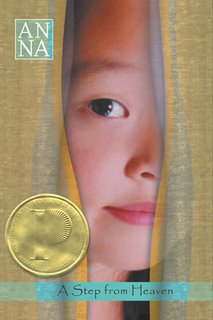
Book Review: A STEP FROM HEAVEN
*NOTE: This review was created for a class at TWU.

1. BIBLIOGRAPHY:
Na, An. 2001. A STEP FROM HEAVEN. Asheville, NC: Front Street. ISBN 1886910588

2. PLOT SUMMARY: In An Na's bittersweet realistic novel, A STEP FROM HEAVEN, Young Ju, a Korean girl, grows up, learns to make her way in America, and struggles to deal with her father's alcoholism and abuse.

3. CRITICAL ANALYSIS:
Often, a writer's first novel contains a very strong voice, but lacks craft, or vice versa. The 2002 ALA Printz Award-winning novel A STEP FROM HEAVEN is an exception, combining a clear voice with a well-crafted plot and structure. An Na's novel spans a girl's life from toddler to university student, and while the novel incorporates themes prevalent in realistic young adult fiction such as independence, generational conflict, powerlessness and dominance, rebellion and self-awareness, it also reflects the protagonist's journey into adulthood with a unique structure.

First, A STEP FROM HEAVEN addresses Young Ju's forays into independence, from the first resistance as a five year old to being pretty because it means "you cannot play in your nice clothes," to the young woman who is able to make straight A's in school, clean house, buy groceries, and cook while her mother works 3 jobs to keep the family together. Young Ju keeps the meaningful ways of her Korean past, but also forges her own path in America, becoming her mother's "strong girl."

The ways of the past, including traditional values such as being an obedient daughter and being subservient to the males in the family, creates a generational conflict between Young Ju and her parents, in particular, her father. As Young Ju matriculates through the American school system, she assimilates in to American culture, and cannot help but compare her family dynamics with those of her friend Amanda. In the chapter entitled "Daughter," Young Ju gets a ride home from an award ceremony at school where she was named 1st in her class. In the car, she smiles as Amanda's father begins to sing along to the radio, and winks at the girls in the rear view mirror. It is a stark contrast to what Young Ju finds at home. While her mother is very pleased with the girl's award, her father makes no mention of it and appears not to even have looked at it until Young Ju notices it has a smudge on it and smells like him, indicating he did see it. Her inability to have a close and loving relationship with her father tears at her, and she thinks, "An ache deep and wide as the sea threatens to drown my heart."

Yet, the conflict in Young Ju's family stems from more than the strictness of a tradition Korean family hierarchy. Young Ju's father, or Apa, is both alcoholic and abusive. Her mother, or Uhmma, is powerless to leave him, and any of her own small acts of rebellion such as demanding to know where he's been are rewarded with slaps and punches. Once Young Ju and her brother Joon are older, they both become victims of abuse, learning to "look blank as if you are listening when really you are trying to fly away from your body" in the face of the verbal abuse that always precedes the beatings. When Uhmma is nearly killed trying to protect Young Ju, the girl finally tips the scales on her father's dominance by calling 911. Although Uhmma refuses to press charges, this act ends the family's powerlessness, and eventually Apa returns to Korea without them.

In addition, A STEP FROM HEAVEN is a deeply personal account of a girl's developing self-awareness. And it is this theme which is most reflected in the novel's structure. Without being contrived, An Na succeeds in creating a narrative voice which ages as Young Ju ages. The first chapters are very short, with simple thoughts and sentences. "Cold. Cold water. Oh. My Toes are fish. Come here. Fast. Look." thinks the toddler Young Ju. Later, on her first day of school in America, five-year-old, Young Ju muses, "I think future must mean a long time away. Except school is not in the future. It is now. I do not understand how school is my future when it is not a long time away." Compare this to the self-assured narration of Young Ju as a high school senior, "The patch of grass is so small you can walk across in four long strides. But I don't care. It is ours. I walk barefoot back and forth across the vibrant green lawn, take in deep breaths of air. My toes clutch the tiny blades, revel in the softness and the damp earth beneath my feet. All ours."

Interwoven within the change in narrative style is not only Young Ju's growth as a young woman, but also her acclimation to America and the English language. Whereas the early chapters are filled with words and phrases she doesn't know yet such as when the teacher says "All right, class, come over here," and Young Ju hears "Ah ri cas, ca mo ve he," the quote above shows a woman whose vocabulary includes words such as "strides," "vibrant," and "clutch." The vivid words of a college bound graduate.

Finally, A STEP FROM HEAVEN, which deals with such difficult issues as abuse and acoholism, is an honest look at the complexity of family dynamics and life. A close look at the structure of the novel reveals that the chapters loosely alternate between good and bad memories, beginning and ending with a good memory. In the beginning, we have the happy memory of a toddler getting her first feeling of being in the ocean, under the safe and comforting watch of a loving relative, whom I assumed to be her grandmother. In the end, sifting through photographs, Young Ju sees one of her with her father, and that memory resurfaces, revealing that her father wasn't always an abusive, distant alcoholic. After living through Young Ju's terrible suffering, the reader glimpses Apa as a dreamer, with a "broad grin" and eyes which crinkle "like the eyes of sleepy cats in the sun," reminding us that people change, and perhaps forgiveness can heal.

An Na's bittersweet optimism, honesty, and shunning of didacticism, along with her evolving narrative style, bring A STEP FROM HEAVEN to a level above many young adult accounts of growing up. Readers will be able to connect with the struggles of Young Ju, and will rejoice in her independence, while gaining an understanding of the immigrant experience.

4. REVIEW EXCERPT(S)
BOOKLIST: (Starred Review) "This isn't a quick read, especially at the beginning when the child is trying to decipher American words and customs, but the coming-of-age drama will grab teens and make them think of their own conflicts between home and outside. As in the best writing, the particulars make the story universal."

PUBLISHERS WEEKLY: "In fluid, lyrical language, Na convincingly conveys the growing maturity of her perceptive narrator who initially (and seamlessly) laces her tale with Korean words, their meaning evident from the context. And by its conclusion, readers can see a strong, admirable young woman with a future full of hope. Equally bright are the prospects of this author; readers will eagerly await her next step."

5. CONNECTIONS & STRATEGIES

* At the high school level, this book would be a good choice for a thematic unit on the immigrant experience in America. Pair A STEP FROM HEAVEN with other titles such as Sandra Cisneros's A HOUSE ON MANGO STREET (ISBN 0679734775) and REMIX: CONVERSATIONS WITH IMMIGRANT TEENAGERS (ISBN 0805051139) by Maria Tamar Budhos,to help students identify issues immigrant teens have at home, in school, and with the older generation. The teacher may want to find people in the community who would be willing to talk about their own immigrant experience and allow the students to conduct their own interviews in person or via email. For an insightful interview with An Na in which she discusses the influence of Sandra Cisneros's novel on her work, go to : http://www.cynthialeitichsmith.com/lit_resources/authors/interviews/AnNa.html

* Since A STEP FROM HEAVEN ends with a new beginning and revelations about Young Ju’s father, it would a good candidate for an activity called “The Rest of the Story.” Students create a summary of the story and then tell “the rest of the story” a la Paul Harvey using the subtext or a follow-up that wasn’t explicitly told. They might explore what happens later, whose story wasn’t told and now will be told, or what new twist or information might be added. For this lesson and other ideas on how to deepen students’ comprehension of texts, see Jeffrey Wilhelm’s ACTION STRATEGIES FOR DEEPENING COMPREHENSION (ISBN 0439218578)